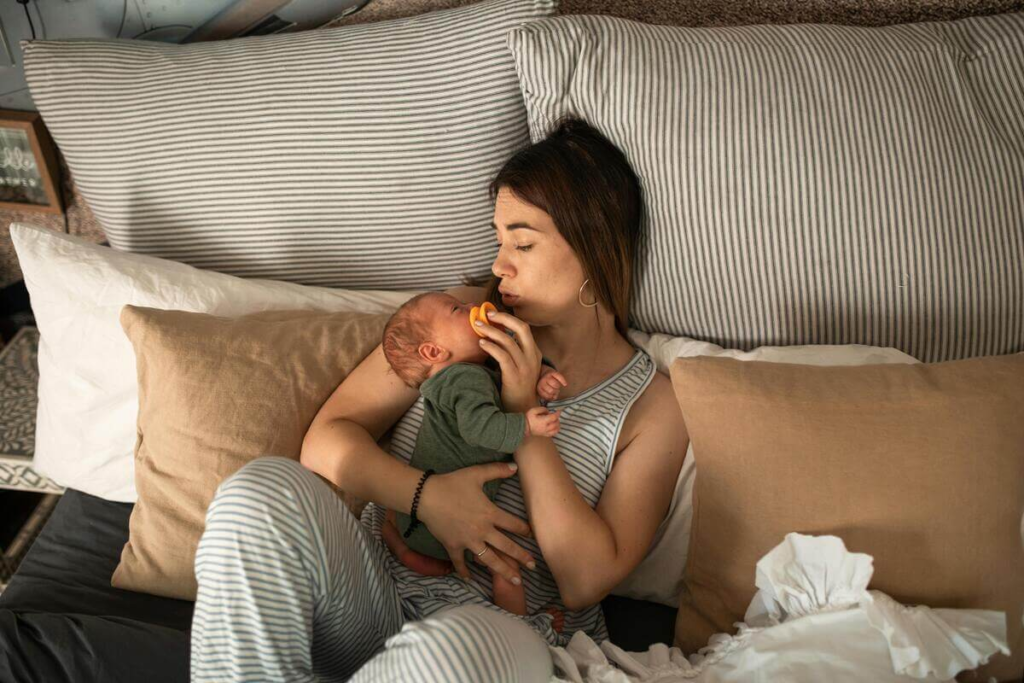
It’s finally your chance to sleep. The room is quiet and your body feels heavy enough to pass out in seconds. But the moment your head hits the pillow, your brain switches on.
You’re wide awake and watching the baby monitor, listening for movement, waiting for a sound that might mean something is wrong.
If you’ve been asking yourself “why can’t I sleep because I keep worrying about my baby?”, this isn’t just in your head. It’s a very specific pattern many new moms fall into, especially in the early weeks despite being severely exhausted.
Why You Feel Exhausted But Still Can’t Sleep
What you’re experiencing is a state of hyper-alertness .
After a having a baby, your brain shifts into a protective mode where it constantly scans for anything that could be a threat. At night, when everything is quiet, that scanning becomes even louder so instead of winding down to sleep, your system stays fully alert.
That’s why you might notice your body feels tired, but your mind is racing, you keep listening for breathing or movement, and you feel like you need to stay semi-awake “just in case.”
This is all because your brain is trying to protect your baby, it just doesn’t know when to switch off.
Is it Normal to Stay Awake Worrying About Your Baby?
Yes, but up to a point.
Many first-time moms go through a phase where they:
- Check the monitor repeatedly
- Stand over the crib to watch their baby breath
- Feel uneasy when the room is too quiet
This usually settles as your body recovers and your brain adjusts to your baby’s patterns.
However, if you can’t sleep even when your baby is safe, feel like you must stay awake to prevent something bad, and are running on almost no rest, then this may be moving beyond normal adjustment and into postpartum anxiety.
Why “Sleep When the Baby Sleeps” Doesn’t Work
This advice sounds simple, but it assumes your body is calm enough to sleep which isn’t the case.
This is because it’s hard to sleep when your brain does not feel safe enough to let go just yet and so it’s busy still checking for danger even when you lie down. That’s why you can be completely exhausted and still unable to fall asleep.
The Cycle That Keeps You Awake
There’s a pattern that quietly reinforces this cycle and it goes like this:
- You have a worrying thought
- Your body reacts (tight chest, alertness)
- You check the monitor or listen closely
- You feel brief relief
- So your brain learns that staying alert “keeps your baby safe”
Therefore, the next time you try to sleep, your brain keeps you awake again so that you can keep baby safe.
This is the same cycle behind why you can’t relax even when your baby is sleeping, and it’s one of the main ways postpartum anxiety keeps itself going.
The Safest Thing You Can Do For Your Baby Is To Sleep
Closing your eyes feels so wrong when you have so many worries in your mind, but it’s true.
If you’re severely sleep-deprived your reaction time, focus, and judgement all drop. In many ways, your brain functions like you’re impaired. That makes everyday things like carrying your baby, preparing a bottle, or driving way more risky than they should be.
Getting some sleep is not a luxury, rather, it’s part of keeping your baby safe. When you’re extremely exhausted and drained, you’re much more likely to accidentally pass out while tending to the baby. That is a safety hazard.
A rested version of you will be way better at reading their cues and making fast decisions, thinking more clearly, and handling situations better.
Essentially, staying awake all night doesn’t increase your baby’s safety. It just drains the person responsible for caring for them.
Focus On What You Can Actually Control
A big part of fear comes from trying to control things that are not fully controllable. It may feel heavy to think about it, but you can really only manage the external factors that keep your baby safe.
Once you have handled these physical conditions, staying awake to watch them doesn’t actually add extra protection, but you sure can sleep better knowing your baby is in the safest environment.
Basic safe sleep practices include:
- Place your baby on their back for every sleep.
- Use a firm mattress on their back
- Keep the crib completely empty with no blankets, pillows, or toys.
- Maintain a comfortable room temperature
- Share the same room (not bed) as your baby for the early months
Once these are in place, your baby is already in a safe setup and your role is no longer to monitor every second.
Why SIDS Fear Feels So Intense at Night
Sudden infant death syndrome (SIDS) is one of the biggest drivers of nighttime anxiety.
Part of the reason it feels overwhelming is because of how it’s talked about online. Social media tends to amplify rare events without context or actual statistics, which makes the risk of SIDS feels constant and immediate.
In reality, the risk is low, especially when safe sleep guidelines are followed.
Nevertheless, the brain responds to uncertainty and so at night with fewer distractions, that uncertainty gets louder. That is why fear tends to spike during those quiet hours.
What Actually Helps You Rest Again
You don’t fix this by forcing yourself to “stop worrying”. You work with your body instead to aim for partial rest because even that helps reset your system. Here are a few things that help:
- Creating distance from the monitor instead of keeping it within reach
- Letting someone else take over with the baby for a set period so you can rest
- Using simple grounding techniques to calm your body before lying down
- Allowing yourself to rest without pressure to fall fully asleep
When to Reach Out For Support
If you notice that you’re barely sleeping, your mind feels constantly on edge at night, and the fear feels impossible to control, it’s worth speaking to a professional.
Postpartum anxiety is common, and support can make a big difference much faster than trying to push through alone.
Final Thoughts
Right now, your brain is doing it’s job a little to well. It’s constantly scrutinizing for possible threats, watching, and staying alert because it thinks that’s the way to keep your baby safe.
But safety doesn’t come from staying awake all night. It comes from a combination of a safe environment, shared responsibility, and a rested, functioning you.
While this face feels intense, it doesn’t last forever. As your body recovers and your confidence grows, that constant alertness starts to settle.
For now, your goal should not be perfect to sleep to start with instead, it should be giving your system enough rest to come back down from this hypervigilance.