
When you’re feeding a newborn several times a night, the last thing you want is to search through drawers for a clean burp cloth or get out of bed because the wipes are across the room.
A well-organized bedside nursing station can make those moments easier. But if you’re sharing a small bedroom with your baby, adding another piece of furniture isn’t always the answer.
The best nursing cart for your space might be a rolling organizer with drawers, a cart with removable compartments, or simply a portable diaper caddy that sits on your existing nightstand.
The key is choosing storage that fits your bedroom and the supplies you actually use. A large cart might be useful for pumping equipment and diapering supplies, while a compact caddy could be all you need for nighttime breastfeeding.
These five nursing carts and diaper caddies offer different ways to organize your essentials without unnecessarily crowding your bedroom.
Disclosure: As an Amazon Associate, I earn from qualifying purchases. This article contains affiliate links. If you purchase through these links, I may earn a commission at no additional cost to you.
1. Parker Baby Felt Diaper Caddy — Best Portable Organizer
Key Specs
- Dimensions: Approximately 16″W × 10″D × 7″H
- Material: Felt
- Storage: Three main compartments and eight exterior pockets
- Portability: Two carrying handles
- Special Features: Removable interior divider
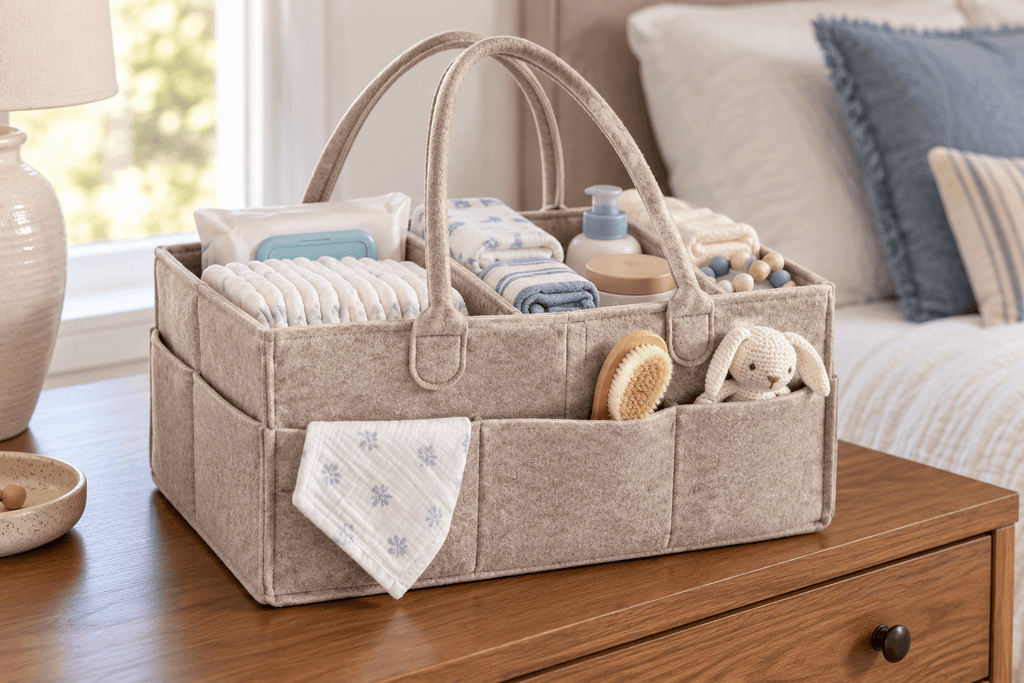
The Parker Baby Felt Diaper Caddy is a practical choice for mothers who want their nursing and diapering supplies organized without adding another piece of furniture to the bedroom.
Unlike a rolling cart, it can sit on an existing dresser, a sufficiently wide nightstand, or another stable surface. You can also carry it between rooms, which is useful if you breastfeed in the bedroom at night but spend most of the day in the living room.
Its removable divider creates three main storage sections. You could use one for diapers, another for wipes and creams, and the third for burp cloths, nursing pads, or other small feeding essentials.
The eight exterior pockets are particularly useful for items that tend to disappear beneath larger supplies. Instead of rummaging through the main compartment for nipple cream or a pacifier case, you can keep smaller accessories separated.
Another advantage is flexibility. Removing the divider creates a larger open compartment for bulkier items, so the caddy can adapt as your baby’s needs change.
However, this particular Amazon variant is the large size, measuring approximately 16 inches wide. That is worth considering and going for the regular size option instead if your nightstand is small. Although it doesn’t take up floor space, it still needs a reasonably generous surface.
The felt material is also less convenient to wipe clean than hard plastic. For everyday nursing supplies, that may not be a major problem, but creams and liquid spills can be messier to deal with.
Pros
- Portable between rooms
- Removable divider allows flexible storage
- Eight exterior pockets keep smaller supplies accessible
- Doesn’t require additional floor space
- Useful beyond the newborn stage
Cons
- Large variant may overwhelm a small nightstand
- Felt isn’t as easy to wipe clean as plastic
- Doesn’t provide separate vertical storage for larger equipment
Best For: Mothers who want one portable organizer for nighttime feeding, diaper changes, and daytime use in different rooms.
Check the Parker Baby Felt Diaper Caddy on Amazon
2. Skip Hop Light-Up Diaper Caddy — Best for Nighttime Access
Key Specs
- Dimensions: Approximately 15″W × 9.5″D × 8.5″H
- Material: Polyester fabric
- Storage: Two main compartments and four additional pockets
- Portability: Integrated carrying handle
- Special Features: Touch-sensitive handle light with automatic shutoff, movable divider exterior pockets
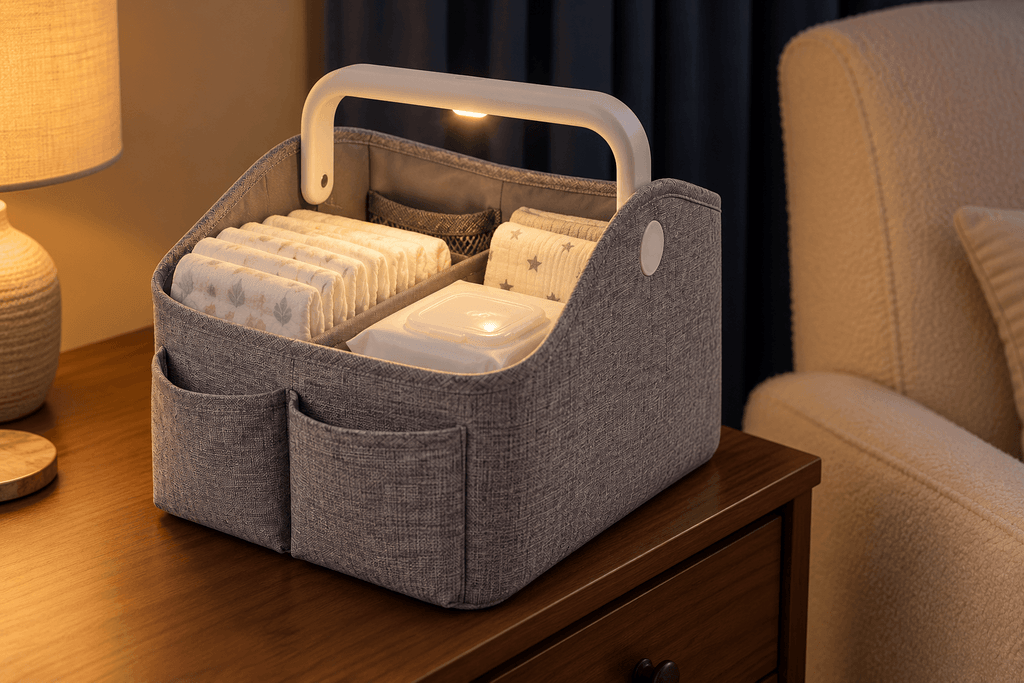
The Skip Hop Light-Up Diaper Caddy stands out for one feature that can be particularly helpful during nighttime newborn care: a built-in light.
Instead of switching on the bedroom’s overhead light every time you need a diaper, wipes, or another small item, you can activate the light in the caddy’s handle.
The light is designed to illuminate the organizer’s contents, making it easier to locate supplies without flooding the room with bright light. It also shuts off automatically after approximately 10 minutes.
That can be useful if you’re sharing a bedroom with your partner or trying to keep the environment calm during nighttime feeds and diaper changes.
The movable center divider lets you organize the interior according to your routine. For example, you could keep diapers and wipes in one section and nursing pads, burp cloths, or a spare baby outfit in another.
Its four pockets offer additional space for smaller essentials.
However, the light is primarily a convenience feature for finding supplies. It shouldn’t be treated as a substitute for adequate lighting when you need to see your baby clearly.
The caddy also measures approximately 15 inches wide, so it isn’t necessarily the best option for a tiny nightstand.
And if you already have a convenient dimmable bedside lamp, the built-in light may not justify choosing this organizer over a simpler caddy.
Pros
- Built-in light helps locate supplies at night
- Automatic light shutoff
- Movable divider for flexible organization
- Four additional pockets
- Portable between rooms
Cons
- Requires a reasonably wide surface
- Built-in light may be unnecessary if you already have bedside lighting
- Limited capacity for bulky pumping equipment
Best For: Mothers who want nursing and diaper-changing supplies organized in one place, with a convenient light for nighttime access.
Check the Skip Hop Light-Up Diaper Caddy on Amazon
3. Modanais 3-in-1 Diaper Caddy Cart — Best Nursing Cart With Drawers
Key Specs
- Dimensions: Approximately 16.15″W × 11.81″D × 35.04″H
- Material: Metal frame with fabric storage components
- Storage: Removable top caddy, open storage, and two fabric drawers
- Portability: Four swivel wheels, two lockable; removable caddy
- Special Features: Detachable compartment dividers
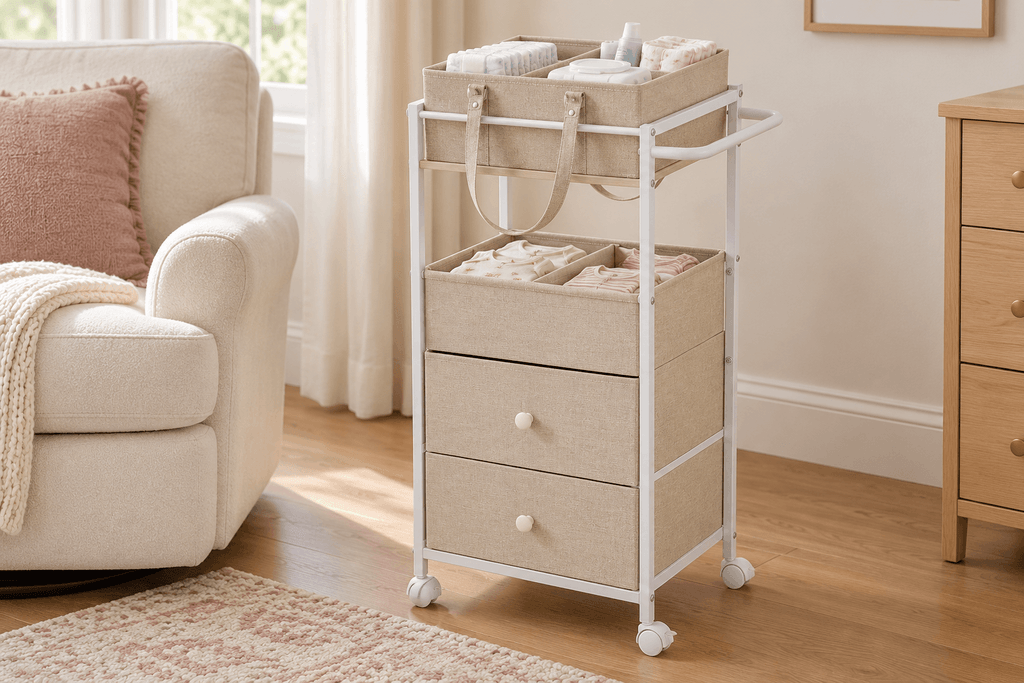
The Modanais 3-in-1 Diaper Caddy Cart is my strongest choice for mothers who want a dedicated nursing station with more organization than a conventional open-shelf cart provides.
Its biggest advantage is the combination of a removable top caddy, accessible storage, and two fabric drawers.
That arrangement is useful because not every nursing or diapering item needs to be visible all the time.
You could keep burp cloths, nursing pads, wipes, and other frequently used supplies in the upper caddy, while reserving the drawers for spare baby clothes, extra diapers, or less frequently needed accessories.
The drawers help prevent the cluttered appearance that open carts can develop when every shelf is filled with small packages and loose supplies.
The removable caddy is another practical feature. If you move from the bedroom to the living room, you can carry the most important supplies without taking the entire cart with you.
Its detachable dividers also allow you to adjust the compartments to suit different items.
For a small bedroom, the footprint is relatively manageable at approximately 16.15 inches wide and 11.81 inches deep. Still, this is a substantial piece of furniture, standing just over 35 inches tall.
That height may be convenient beside a feeding chair, but it could make the top difficult to reach comfortably from a low bed.
The fabric drawers also introduce a trade-off. They keep items concealed, but you need enough clearance to pull them out. If the cart is squeezed tightly between the bed and another piece of furniture, the drawers may become awkward to use.
Before buying, measure not only the cart’s footprint but also the space required to access its drawers.
Pros
- Two drawers keep smaller items concealed and separated
- Removable top caddy adds portability
- Detachable dividers allow flexible organization
- Combines open and enclosed storage
- Locking wheels help keep the cart in position
Cons
- Requires dedicated floor space
- Drawers need clearance to open
- Fabric drawers aren’t as convenient to wipe clean as hard plastic
- May be taller than ideal for use beside a low bed
Best For: Mothers who want a permanent bedside nursing station with separate storage for feeding supplies, diapering essentials, and spare baby items.
Check the Modanais 3-in-1 Diaper Caddy Cart on Amazon
4. Lidtop 2-in-1 Diaper Caddy Cart — Best With a Removable Caddy
Key Specs
- Dimensions: Approximately 17″W × 11″D × 33″H
- Material: Metal frame with additional storage components
- Storage: Three storage tiers with divided compartments
- Portability: Four swivel wheels and removable caddy
- Special Features: Detachable top organizer
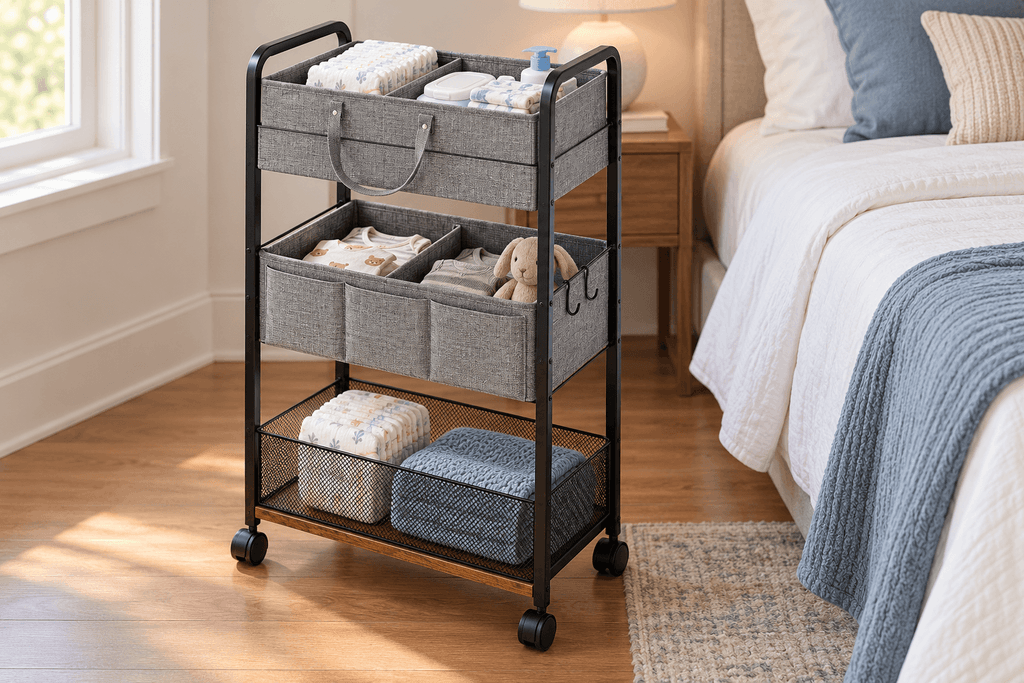
The Lidtop 2-in-1 Diaper Caddy Cart is designed for mothers who want the storage capacity of a rolling cart but don’t necessarily want to move the entire cart every time they change rooms.
Its defining feature is the detachable diaper caddy.
You can keep the main cart beside your bed with extra diapers, wipes, burp cloths, and other supplies, then lift the caddy away when you need a smaller selection of essentials elsewhere.
That is especially useful if your baby sleeps in your bedroom but you spend much of the day in another room.
The three-tier arrangement provides more storage than a standalone diaper caddy. You could organize the upper level around nighttime feeding, reserve another level for diaper-changing supplies, and use the remaining space for backups.
Unlike the Modanais cart, however, the Lidtop emphasizes accessible storage and portability rather than enclosed drawers.
That makes it convenient when you want to see supplies immediately, but it also means small items can accumulate across the shelves unless you organize them carefully.
Its approximately 11-inch depth is reasonable for a dedicated bedside cart, although its 17-inch width still needs to be measured against your available space.
One consideration is the removable caddy itself. Before moving it, make sure it is properly lifted from the cart and that heavier items are distributed evenly.
You should also avoid overloading the upper level, particularly if the cart is positioned where it might be bumped.
Pros
- Combines a rolling cart with a removable caddy
- Three storage levels
- Useful for moving essentials between rooms
- Divided compartments help separate supplies
- Open storage makes items easy to locate
Cons
- Open shelves can look cluttered
- No enclosed drawers for hiding smaller supplies
- Requires more floor space than a standalone caddy
- Not as compact as a genuinely slim rolling cart
Best For: Mothers who want a dedicated bedside storage cart but also need a portable caddy for daytime feeding and diaper changes.
Check the Lidtop 2-in-1 Diaper Caddy Cart on Amazon
5. Neycil Divided Diaper Cart — Best for Organized Compartments
Key Specs
- Dimensions: Approximately 15.7″W × 11.8″D × 34.8″H
- Material: Fabric storage sections; frame material not independently confirmed
- Storage: Three tiers with seven divided compartments
- Portability: Swivel wheels, including two lockable wheels
- Special Features: Water-resistant fabric sections
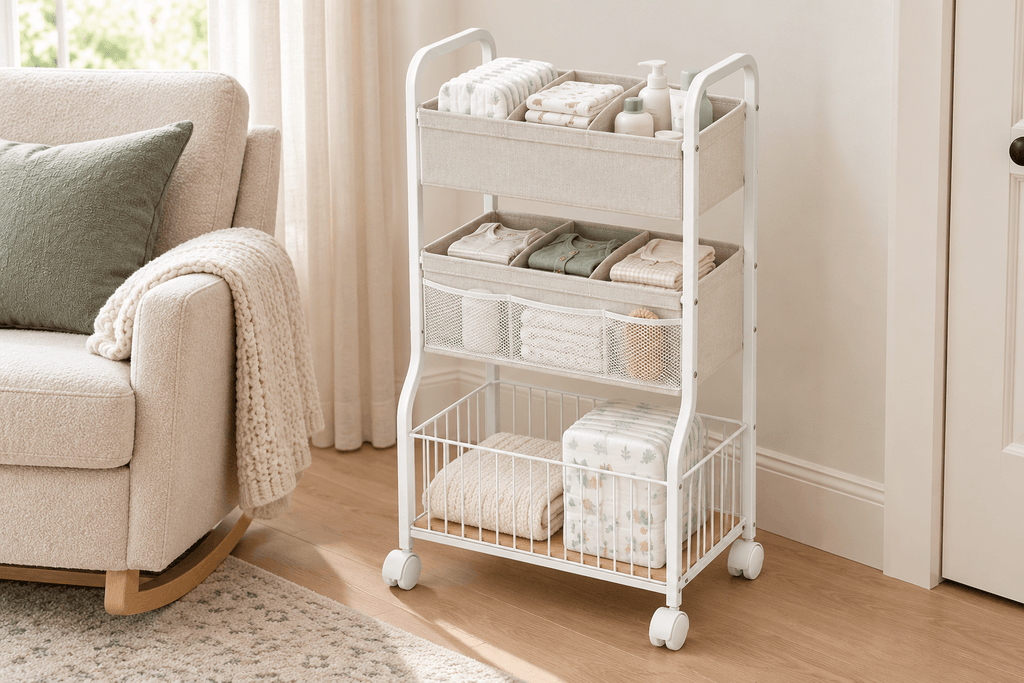
The Neycil Divided Diaper Cart is worth considering if you like the accessibility of open shelving but don’t want all your nursing and diapering supplies mixed together.
Its main advantage is the divided storage arrangement.
A conventional utility cart gives you three large baskets and leaves you to figure out how to separate everything. With the Neycil design, the dividers create smaller sections for organizing different categories of supplies.
For nighttime feeding, that could mean keeping nursing pads and burp cloths in one section, diapers and wipes in another, and spare baby clothes or changing accessories elsewhere.
This setup may be particularly useful if you dislike searching through a large basket for one small item.
Because the compartments are open, you can see what needs restocking without opening drawers.
That also makes it easier to grab frequently used supplies with one hand, provided the cart is positioned safely and within comfortable reach.
The trade-off is that the divided compartments restrict the size of what you can store.
Large pumping equipment, bulky packages, or oversized containers may fit less comfortably than they would in a cart with open, undivided shelves.
And although compartmentalized storage can make a cart look tidier, it doesn’t automatically make it smaller. You still need to measure the available bedside floor space before purchasing.
Compared with Modanais, Neycil is the better concept for mothers who prefer visible, separated supplies. Modanais is the stronger choice when concealed drawers are important.
Pros
- Dividers help separate different baby-care essentials
- Open compartments make supplies easy to see
- Three storage levels
- Locking wheels
- Useful for organizing many small items
Cons
- Dividers limit space for larger items
- No enclosed drawers
- Open compartments still need regular tidying
- Requires dedicated floor space
Best For: Mothers who want clearly separated compartments for nursing and diapering essentials without having to open drawers.
Check the Neycil Divided Diaper Cart on Amazon
Nursing Cart or Diaper Caddy: Which Is Better for a Small Bedroom?
If you’re trying to organize a bedside nursing station, the first decision isn’t which product looks nicest. It’s whether you actually need another piece of furniture.
A diaper caddy is usually the better starting point if you already have a dresser, nightstand, or other stable surface near your feeding area.
It keeps essentials together, can be moved between rooms, and doesn’t take up additional floor space.
The Parker Baby caddy is particularly useful for general portability, while Skip Hop adds a convenient lighting feature for nighttime access.
A nursing cart makes more sense when your existing furniture doesn’t provide enough storage or when you’re organizing a larger collection of feeding and diapering supplies.
For example, mothers who pump may need space for clean pump accessories, storage bags, spare parts, and other equipment in addition to regular baby-care items.
A cart with drawers, such as Modanais, can help keep those supplies separated. A cart with a removable caddy, such as Lidtop, offers more flexibility if you regularly move between rooms.
However, a rolling cart isn’t automatically more practical than a basket. If it blocks a walkway, prevents a drawer from opening, or makes it difficult to get out of bed, it may create more inconvenience than it solves.
What to Look for in a Nursing Cart for a Small Bedroom
1. Measure the Footprint, Not Just the Height
A tall cart can look compact in product photographs because it uses vertical storage. But its width and depth determine how much floor space it actually occupies.
Measure the area beside your bed or feeding chair before shopping.
Check whether the cart will interfere with bedroom doors, dresser drawers, closet access, or the space you need to walk around the bed.
If you’re considering a cart with drawers, remember to leave enough clearance to open them fully.
2. Think About How You Access Supplies While Seated
The most useful nursing station is one you can reach without twisting awkwardly, stretching, or repeatedly getting up.
Consider the height of your bed or feeding chair. A cart with a high top shelf may work beautifully beside an armchair but be inconvenient next to a low platform bed.
Likewise, a cart positioned behind you may offer plenty of storage but little practical convenience during feeding.
Keep frequently used supplies in the most accessible section and place backup items farther down.
3. Decide Whether Drawers or Open Compartments Suit You Better
Drawers and open compartments solve different problems.
Drawers are useful for keeping spare supplies concealed and preventing small packages from making your bedroom look cluttered. However, you need space to open them, and they can be inconvenient if you frequently need something while holding your baby.
Open compartments make it easier to see and retrieve supplies quickly. They’re especially useful for items you reach for several times a day. However, they can become messy if everything is placed loosely on the shelves.
For a combination of both, a cart with open storage and drawers may be the most flexible option.
4. Consider Portability
If you feed your baby in different rooms, think about how you’ll move your supplies.
A standalone caddy is easy to carry and doesn’t require you to roll furniture through doorways. A cart with a detachable caddy offers a useful middle ground: larger storage in the bedroom and a smaller organizer you can take elsewhere.
A full rolling cart may be better if you need to move larger quantities of supplies, but its wheels should move smoothly over your flooring.
5. Choose Storage That Is Easy to Maintain
Nursing and diapering supplies don’t always stay perfectly clean. Wipes, creams, spilled liquids, and damp cloths can make storage messy.
Hard surfaces are generally easier to wipe down. Fabric drawers and felt organizers may need more careful cleaning and drying.
If you plan to store pumping equipment, use separate, clean storage for parts that have been properly washed and dried. Don’t use an organizer as a substitute for appropriate pump-part cleaning or breast milk storage.
How to Organize a Bedside Nursing Cart for Night Feeds
You don’t need to fill every compartment to make a nursing cart useful. Start with the items you actually reach for during nighttime feeds.
Keep burp cloths, nursing pads, nipple cream if used, and other frequently needed feeding accessories in the top or most accessible section.
If you change diapers in the bedroom, organize diapers, wipes, and a spare outfit in a separate compartment.
Use lower shelves or drawers for backup supplies rather than crowding the top of the cart.
Keep your own water bottle on a stable surface where you can reach it comfortably, away from your baby and electrical equipment.
If you’re using a cart with dividers, give each category a designated place. That makes it easier to restock supplies and find what you need when you’re tired.
Avoid overloading the cart or adding unnecessary accessories simply because there is empty storage space. A well-organized nursing station should make nighttime care easier, not become another area of the bedroom that constantly needs tidying.
Nursing Cart Safety Around Babies and Toddlers
A nursing cart may be convenient during the newborn stage, but its position and contents should be reconsidered as your baby becomes more mobile.
Keep rolling carts on a stable, level surface and engage wheel locks when available.
Place heavier items on lower shelves to reduce the risk of tipping, and avoid hanging heavy bags from cart handles or upper compartments. Do not assume that locking wheels make a cart tip-proof.
Keep medications, creams, small accessories, plastic bags, cords, and other potentially hazardous items securely out of children’s reach.
As your baby begins crawling, pulling up, or walking, a low cart may become accessible. Move hazardous supplies to secure storage and reassess whether the cart remains appropriate for the room.
Never place a nursing cart, diaper caddy, nursing pillow, or loose supplies inside a baby’s crib or bassinet.
For safe sleep, keep the baby’s sleep surface firm, flat, and free from loose bedding, pillows, and other objects.
A nursing station should make caring for your baby more convenient while keeping the sleep area clear and safe.