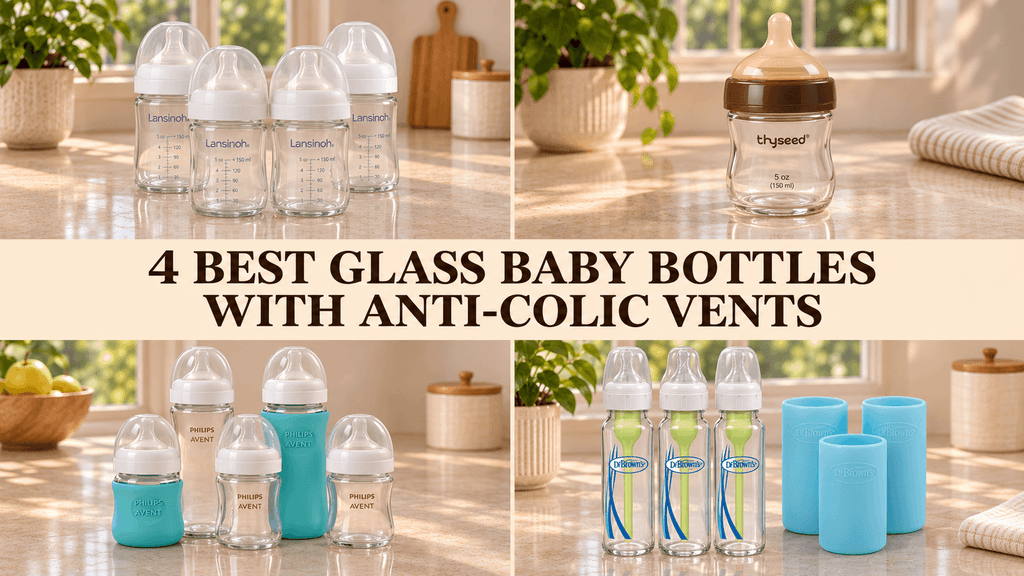
If you are searching for the best glass baby bottles with anti colic vents, chances are you have a baby who gets gassy, fussy or spitty at feeds, and you are hoping a bottle can make those moments a little gentler.
That hope is completely understandable. Glass appeals to many parents because it feels clean and does not hold on to odors, and a good vent is meant to cut down on the air your baby swallows.
We researched four popular options, and this guide explains how each vent works, what to watch for and who each bottle suits.
A quick honest note. No bottle can promise to cure colic, and babies are very different from one another. These picks are about giving you well designed tools, not guarantees.
Disclosure: As an Amazon Associate, I earn from qualifying purchases. This article contains affiliate links. If you buy through them, I may earn a commission at no additional cost to you.
Quick Picks
- Dr. Brown’s Options+ Narrow Glass — Best With an Internal Vent
- Philips Avent Natural Response Glass — Best Two-Size Starter Set
- Thyseed Anti-Colic Glass — Best With a Bottom Vent
- Lansinoh NaturalWave Glass — Best Extra-Slow-Flow Multipack
How We Chose These Bottles
We researched each one by reading the maker’s own product information, comparing how the vent works and what is included, and looking at what verified buyers say about everyday use. We judged them on the quality of the glass, the vent design and how easy it is to clean, the nipple and flow options, and how well they grow with your baby.
The picks reflect those differences in everyday use. This guide is based on product research. The recommendations reflect the designs and pack contents.
Why Do Parents Choose Glass Baby Bottles With Anti-Colic Vents?
The Vent Gives Air a Way Into the Bottle
As milk leaves a bottle, air needs a way in to replace it. A vent gives incoming air a route and helps relieve the vacuum that can build during a feed. Parents often look for a vented bottle when their baby gulps or seems gassy after feeds. The design can change how air moves through the bottle, and how much air a baby swallows can also depend on the nipple flow and how they feed.
However there’s limited evidence for brands’ claims about preventing gas.
Glass Appeals to Parents Who Want a Glass Surface for the Milk
The bottle body is glass, so you can see what’s left and check the inside after washing. You’ll still handle silicone nipples and other components, and the bottle itself tends to be heavier than plastic. That weight is easier to live with when bottles mostly stay at home. It matters more when you carry several in a diaper bag, and glass can break if dropped.
The Vent Design Changes What You Handle After Each Feed
With a nipple valve, the vent is in a piece you already remove. An internal tube gives air a separate path inside the bottle, and you’ll wash the tube and insert individually. A base valve puts the air inlet at the bottom, where it has its own cleaning instructions. If you wash several bottles at once, those small differences add up. Compare the number and shape of the parts you’ll handle alongside the bottle capacity and nipple flow.
1. Dr. Brown’s Options+ Glass — Best With an Internal Vent
Key Specs
- Bottle capacity: 8 oz narrow or 9 oz wide-neck
- Pack size: Three bottles in either linked pack
- Vent location: Removable assembly inside the bottle
- Included nipple flow: Level 1 slow flow
- Neck style: Narrow or wide, depending on the version
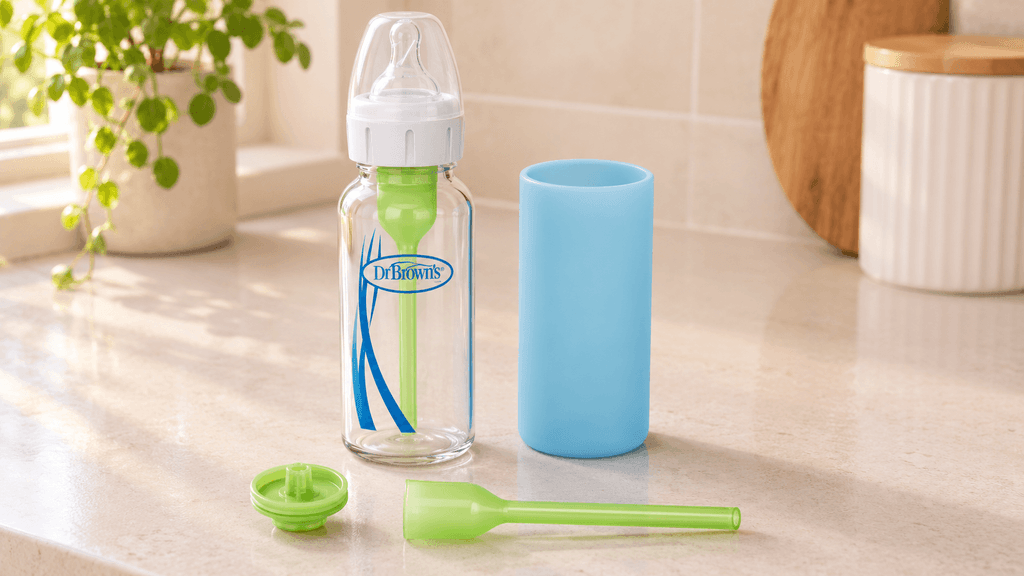
Dr. Brown’s is the bottle many people think of when they hear anti colic, and the internal vent is the reason.
A small vent insert sits inside the bottle and moves air away from the milk so that less of it ends up in your baby’s tummy.
Dr. Brown’s says the system is clinically proven to reduce colic and decrease spit up, burping and gas. That is the brand’s claim, and results vary from baby to baby, but it explains why this bottle has such a loyal following. The vent can be removed as your baby grows, so you are not locked in for good.
The narrow glass is heat and thermal shock resistant, and the bottle is dishwasher safe on the top rack and sterilizer safe.
The downside is dealing with extra pieces and one buyer noted that there are a lot of them. With the vent installed, you have a separate insert and reservoir tube to disassemble and wash alongside the bottle, nipple, collar, and cap. Think about that across an entire day’s bottles. With three bottles in rotation, you’ll have three vent assemblies to keep track of, and the narrow passages require more attention than the inside of the glass bottle.
The 8 oz narrow version gives you a slimmer bottle with the narrow nipple shape. The linked blue bundle includes silicone sleeves. The 9 oz wide-neck version gives you a larger opening for filling and brushing, with a different nipple shape. Both use the same type of internal vent, so moving to the wider opening doesn’t change the basic vent-cleaning routine. Choose the neck style before ordering spare nipples.
Pros
- A well known vent with a long track record.
- The removable vent gives you flexibility within the Options+ system.
- The wide-neck version gives you more room to fill and brush the bottle.
- Dishwasher and sterilizer safe.
- Silicon sleeves included for the 8 oz bottles
Cons
- More parts to wash and reassemble.
- Narrow and wide versions use different nipple shapes, which matters when buying spares.
Best for: Parents who want a classic vented bottle and do not mind a few extra parts. Skip it if you want the simplest possible cleanup.
Check the 8 oz narrow three-pack on Amazon
Check the 9 oz wide-neck three-pack on Amazon
2. Philips Avent Natural Response Glass — Best Two-Size Starter Set
Key Specs
- Bottle capacity: 4 oz and 8 oz
- Pack size: Three 4 oz bottles and two 8 oz bottles
- Vent location: Valve built into the Natural Response nipple
- Included nipple flow: Flow 2 with the 4 oz bottles and Flow 3 with the 8 oz bottles
- Neck style: Wide
This Philips Avent set takes a simpler approach to venting. Instead of a separate insert, the anti colic valve is built into the Natural Response nipple, so there is one less part to wash and lose.
The wide, breast shaped nipple is designed to support a natural latch and lets your baby control the pace of the flow, and the wide neck makes filling and cleaning easier.
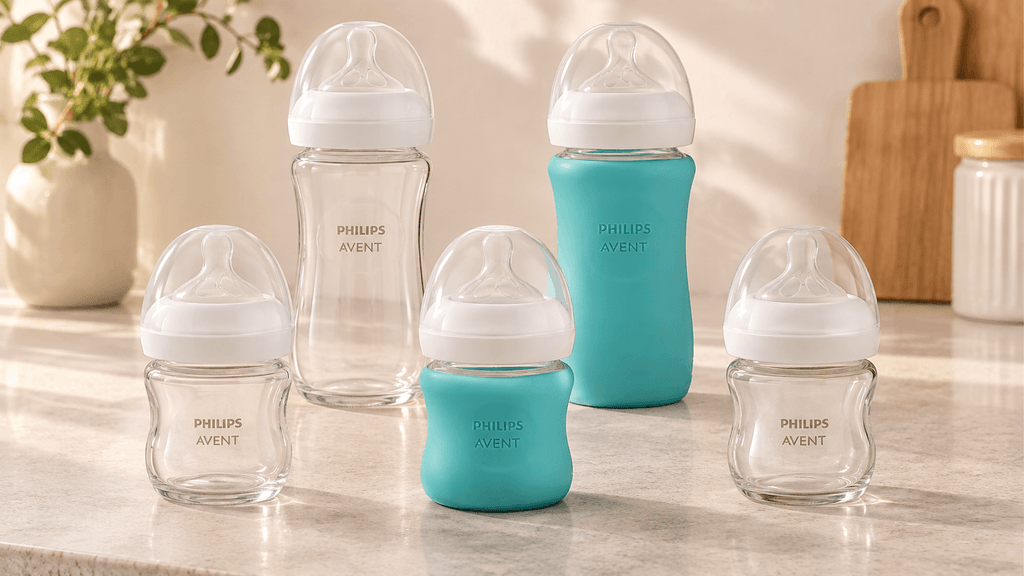
It is also the most complete starter set here. You get three 4 oz bottles with flow 2 nipples and two 8 oz bottles with flow 3 nipples, so you are covered for a while. The nipple is the detail to pay attention to when you move from the small bottle to the large one. The set includes Flow 2 and Flow 3, so picking up an 8 oz bottle from the set can change the included flow as well as capacity. Philips also lists the Natural Response glass bottle separately from its Anti-colic bottle system.
The glass is borosilicate and heat and thermal shock resistant, and the set includes two silicone sleeves, one for each size, though not one for every bottle.
Pros
- You get two capacities in one set.
- The built-in valve keeps the parts count low.
- The wide opening gives you room to reach inside with a brush.
Cons
- The two capacities come with different nipple flows.
- Only two sleeves for five bottles
Best for: Parents who want both bottle sizes from the start with a simple venting design. Skip it if you want a bottle with a dedicated vent insert.
Check the Philips Avent glass gift set on Amazon
3. Thyseed Anti-Colic Glass — Best With a Bottom Vent
Key Specs
- Bottle capacity: 5 oz
- Pack size: One bottle
- Vent location: Valve at the base
- Included nipple flow: Newborn extra-slow flow on the linked variant
- Neck style: Wide
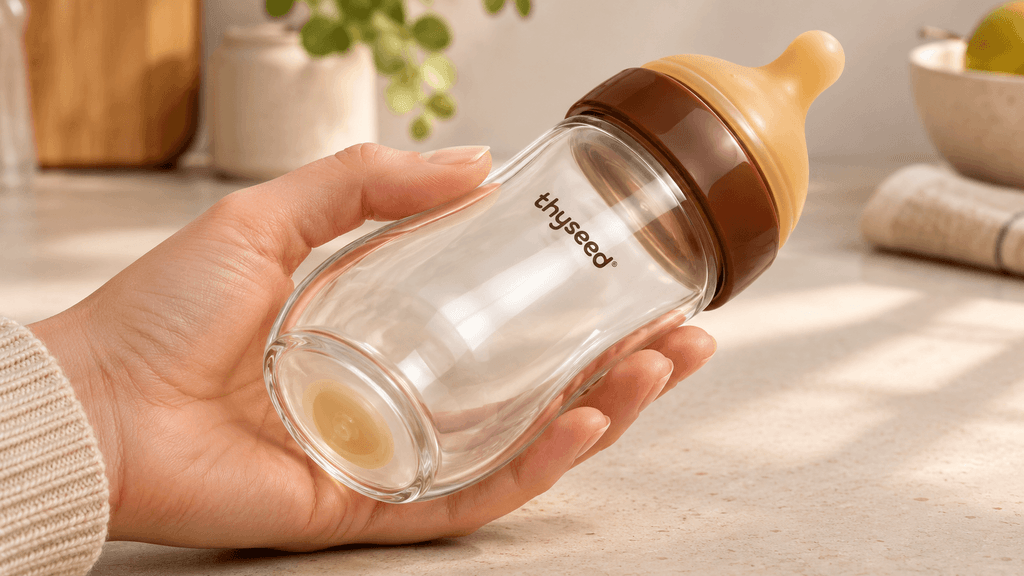
Thyseed is the most distinct design here because the valve sits below the bottle rather than inside the nipple or on an internal tube. This keeps the inside of the bottle open and easy to reach.
The brand says its bottom vent design is clinically studied and reduces colic and spit up, which is its own claim, so treat it as a promise to test rather than a guarantee.
Buying the single borosilicate glass 5 oz bottle gives you a chance to see how that layout fits your routine before you commit to a set. The newborn variant also gives you an extra-slow-flow nipple in the box.
The cleanup question is how you’ll handle the bottom valve. You still have a vent component to care for, and it needs attention in a different place from the nipple and collar. Thyseed’s cleaning illustration specifically cautions against poking the valve with a brush. If you tend to clean bottles quickly in batches, look at the brand’s component diagram before ordering so you know what you’ll be taking apart and how the valve should be cleaned. The bottle is also described as dishwasher and sterilizer safe.
Buyers generally like how easy the bottom vent is to take off and clean compared with an internal insert, and they praise the wide opening for scooping powder or filling with milk.
Pros
- The bottom vent is easy to remove and clean.
- A single bottle lets you try the base-vent design before buying multiples.
- The linked newborn version includes an extra-slow-flow nipple.
Cons
- The bottom valve adds its own cleaning step.
- The linked pack contains one bottle, so you’ll need another bottle if you want a backup ready.
Best for: Parents who like the idea of a vent that sits at the bottom and is easy to wash.
Check the Thyseed 5 oz glass bottle on Amazon
4. Lansinoh NaturalWave Glass — Best Multipack for Extra-Slow-Flow Multipack
Key Specs
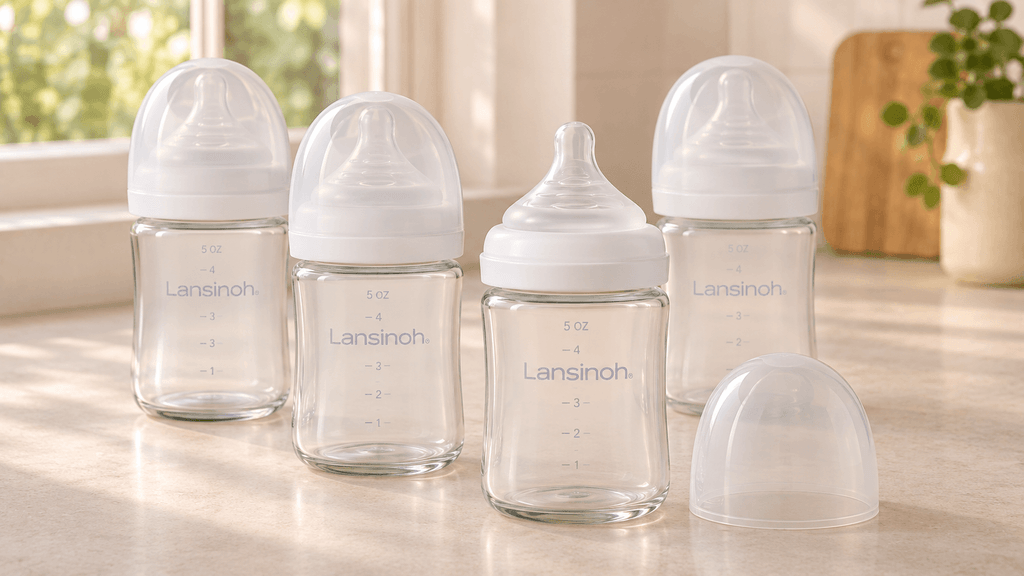
- Bottle capacity: 5 oz
- Pack size: Four bottles with white collars and protective caps
- Vent location: Air valve built into the NaturalWave nipple
- Included nipple flow: XS extra slow on the linked variant
- Neck style: Wide
Lansinoh built its bottle around breastfeeding. The NaturalWave nipple has a wide, textured base and a gentle slope that is meant to encourage a natural latch, and the Air Ventilation System is built right into the nipple, so there are no extra vent parts to wash.
Lansinoh says the system is clinically proven to reduce gas, spit up and fussiness, which is again the brand’s claim.
What makes it a good multipack pick is the flow range. Lansinoh nipples come in extra slow, slow, medium and fast, and they fit all Lansinoh bottles, so you can match the flow to your baby as they grow. Because of that, this is the pack I’d choose if you already want four small glass bottles with say, the same extra-slow-flow nipple. Every bottle in this exact variant would come with an XS NaturalWave nipple. That makes the set easy to rotate between washes or hand off to another caregiver.
The bottle is just three pieces plus a cap (bottle, collar and nipple), made from borosilicate glass, and buyers like that it is thick without being bulky.
Pros
- All four bottles come with the same nipple flow.
- The vent is built into the nipple, keeping assembly simple.
- Each bottle has a protective cap.
Cons
- Four matching bottles are a commitment if your baby hasn’t tried NaturalWave.
- The 5 oz capacity gives you less room than the larger options if you already need it.
- Top rack only in the dishwasher.
Best for: Breastfeeding parents who want a slow flow bottle and a multipack of glass. Skip it if you want a bottle with a dedicated vent insert.
Check the Lansinoh 5 oz XS four-pack on Amazon
What to Check Before Buying Anti-Colic Glass Bottles
Picture a Full Wash, Including the Vent
Lay out what you’d wash after a typical day. A vented nipple keeps the vent in a piece you already need to wash. Dr. Brown’s adds an insert and tube when the vent is installed, while Thyseed puts the valve at the base. If you use a sterilizer, the number and shape of the pieces also affect how much you can fit in one load. See whether you need a bottle drying rack if you have a sterilizer for help planning where those pieces will dry.
Check Nipple Flow and Capacity Separately
Bottle capacity tells you how much the bottle holds. The nipple in the box determines which flow you start with. The Dr. Brown’s 8 oz set includes Level 1 slow-flow nipples, the Lansinoh 5 oz pack includes XS nipples, and the Avent set ships with two different flows. If you’re ordering spares, match the bottle line and the flow you want. Brands use different flow labels, so compare the exact nipple rather than assuming similar names mean the same thing.
Decide How Many Bottles You Want to Try First
A single bottle makes sense if you’re still finding a nipple shape or vent layout that works for your family. A matching multipack becomes more convenient once you know you’ll use it. If you’re comparing anti-colic claims, focus on how the bottle is designed to vent and how it fits your routine. The American Academy of Pediatrics’ parent resource points out the limited evidence behind claims that one bottle brand prevents gas better than another.
Frequently Asked Questions
Do anti colic bottles really work?
Brands cite clinical claims, and many parents find that a vented bottle helps with gas and spit up. But results vary from baby to baby, and no bottle is a cure for colic. Think of a good vent as one helpful tool among several.
Which anti colic vent is easiest to clean?
Generally, the fewer the parts, the easier it is. Avent and Lansinoh build venting into the nipple, so there is no separate vent to wash. Thyseed’s bottom vent is described as easy to remove, and Dr. Brown’s internal vent adds the most pieces.
Are glass bottles good for anti colic feeding?
The venting works the same in glass as in plastic. The difference is the material. Glass is easy to clean and does not hold odors, but it is heavier and can break, so it needs gentle handling.
Can I put these bottles in the dishwasher or sterilizer?
Usually, but follow each maker. Dr. Brown’s lists its glass bottles as dishwasher safe on the top rack and sterilizer safe, Thyseed lists them as dishwasher and sterilizer safe, and Lansinoh says top rack only. For Avent, check the manual.
When should I change the nipple flow?
Follow each brand’s age guidance and watch your baby’s cues. Choking, gulping or milk leaking from the mouth can signal that the flow is too fast, while frustration or very long feeds can suggest it is too slow. A lactation consultant can help.