
Shopping for a nursery recliner gets frustrating when every chair looks cozy online, but sitting back means losing contact with the floor. Add a footrest that takes a determined kick to close, and a relaxing feeding chair can become something you struggle to get out of.
The best nursery recliner for short moms needs to work when you sit upright, feed your baby, and stand up again. A lower seat helps, but its depth and controls can matter just as much.
These three powered recliners offer different compromises. Suzy Electronic has the shallowest published seat in this comparison. Chita adds an independently adjustable power headrest. Kiwi has the clearest shorter-owner feedback, including accounts that explain where the fit falls short.
None is a guaranteed fit at a particular height. A mom who is 4′10″ can have very different floor-reach needs from someone who is 5′3″, and two people of the same height can have different leg and torso proportions.
Disclosure: As an Amazon Associate, I earn from qualifying purchases. This article contains affiliate links. If you buy through them, I may earn a commission at no additional cost to you.
Quick Picks: Nursery Recliners for Short Moms
- Best for a shallower seat: DaVinci Suzy Electronic Recliner and Swivel Glider.
- Best for adjustable head support: Chita Power Nursery Swivel Glider Recliner with Power Headrest.
- Best for short moms who prefer a roomier chair: Babyletto Kiwi Electronic Recliner and Swivel Glider.
How We Chose These Nursery Recliners
We selected these three chairs around the everyday problems shorter moms face: sitting back without losing foot support, finding comfortable head and back support, and closing the footrest before standing up with a baby.
We compared seat height and depth together, rather than relying on overall chair dimensions or “compact” descriptions. Suzy Electronic stood out for its shallower published seat. Chita offered independently adjustable head support. Kiwi earned consideration through specific shorter-owner accounts describing both its comfort and its fit compromises.
All three have powered reclining controls, removing the need to force a manual footrest closed with your legs. That convenience matters, but we also considered the upright sitting position: easy reclining does not compensate for a seat that leaves you uncomfortable during feeds.
Our assessment combines manufacturer specifications, independent reviews, and owner feedback. This is a research-based comparison, not a hands-on test. Height-specific owner evidence is strongest for Kiwi; our assessment of Suzy Electronic and Chita relies more heavily on their measurements and features.
These are three options worth comparing for different needs not a promise that every chair will fit every short mom. Each review explains the reason to consider it and the compromise to check before buying.
1. DaVinci Suzy Electronic — Best for a Shallower Seat
Key Specs
- Seat height: 19.25 inches.
- Seat depth: 20.5 inches.
- Recline controls: Electronic, with push-button controls.
- Head support: High pillowback; no independently adjustable power headrest advertised.
- Movement: Gliding motion and 270-degree swivel.
- Weight capacity: 300 lb.
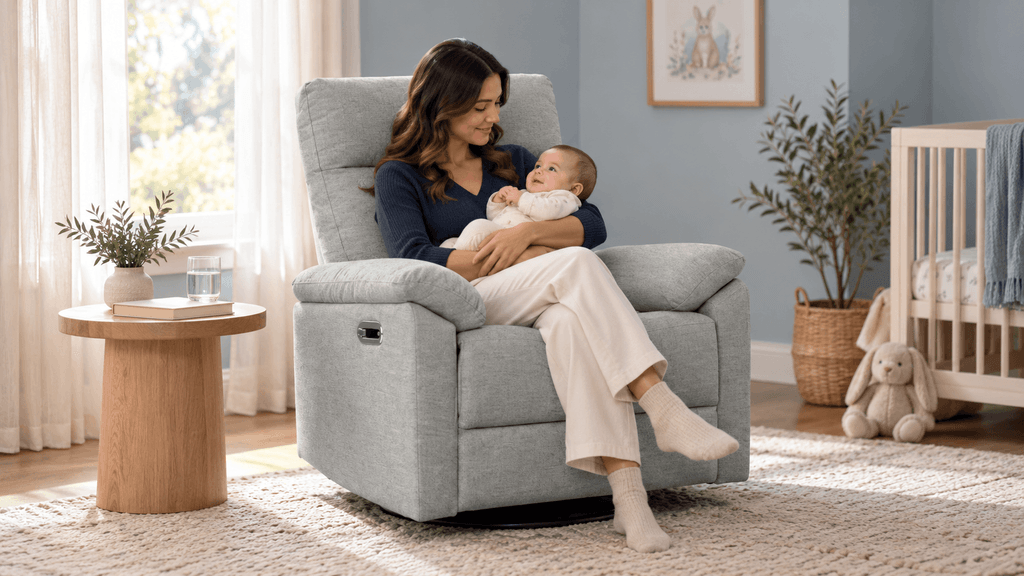
Suzy Electronic is the first chair to compare if deep seats usually leave you perched near the front edge. Its published seat depth is 0.8 inch shorter than the Chita model here and 1.5 inches shorter than Kiwi’s. Those differences are modest, but they give it a useful starting advantage for shorter thighs.
The powered mechanism is the other reason it earns a place. You can return the recliner upright using its controls instead of trying to close a footrest with your calves. That removes one task from the process of standing up; you still need to assess whether the upright seat supports you comfortably.
Owner feedback on the electronic version includes a verified purchaser who was glad to have chosen power and described its movement as gentle and quiet. That supports its convenience, but it does not establish floor reach for a shorter user.
For moms 5′0″ and below, the 19.25-inch seat height still deserves scrutiny. The shallower seat makes Suzy worth comparing, but it does not promise that your heels will rest on the floor. Readers around 5′1″–5′3″ should also compare it with a chair that already fits them rather than assuming the height label settles the question.
The reason to choose Suzy is practical: you want powered reclining with less published seat depth than the other options here. If you want to adjust head support separately from the reclining back, Chita offers a feature Suzy does not advertise.
Pros
- Shallowest published seat in this comparison.
- Powered return avoids kicking a manual footrest closed.
- Owner feedback supports gentle, quiet powered movement.
Cons
- Comfortable floor reach is not established for readers under 5′0″.
- Limited verified height-specific feedback for the electronic version.
- No independently adjustable power headrest advertised.
Check the DaVinci Suzy Electronic on Amazon
2. Chita Power Nursery Recliner with Power Headrest — Best for Adjustable Head Support
Key Specs
- Seat height: 19.3 inches.
- Seat depth: 21.3 inches.
- Recline controls: Electronic, with powered reclining controls.
- Head support: Independently adjustable power headrest.
- Movement: Gliding motion and 270-degree swivel.
- Weight capacity: 350 lb.
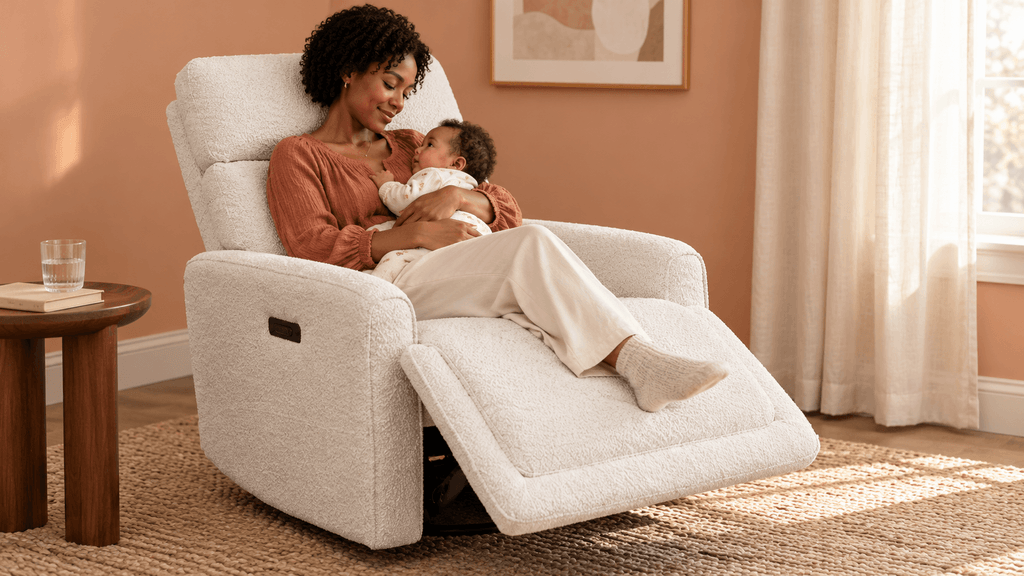
This Chita earns consideration because its headrest can be adjusted independently. If a fixed head cushion meets the wrong part of your neck, changing the headrest position gives you another way to seek support without changing the entire reclining angle.
Its seat is lower and shallower than Kiwi’s published measurements below, but deeper than Suzy Electronic’s above. The seller’s suggested user-height range begins at 5′1″. That makes it a more defensible comparison option for the 5′1″–5′3″ group than a confident recommendation for someone who is 4′10″.
The headrest and seat measurements are reasons to investigate it; they are not proof that petite owners consistently find it comfortable. Even an adjustable headrest cannot shorten the seat or lower it toward the floor.
Choose it over Suzy when independently positioning your head support matters more than having the shallowest seat of these three. If your main problem is reaching the floor while sitting fully back, the extra adjustment should not distract from that requirement.
Pros
- Headrest adjusts independently of the reclining back.
- Powered operation avoids manual footrest-closing effort.
- Lower published seat than Kiwi, with a 350 lb capacity.
Cons
- Limited verified petite-owner feedback for this exact model.
- Seller’s suggested height range does not cover readers under 5′1″.
- Headrest adjustment does not solve excessive seat depth or height.
Check the Chita Power Nursery Recliner with Power Headrest on Amazon
3. Babyletto Kiwi Electronic — Best for Short Moms Who Prefer a Roomier Chair
Key Specs
- Seat height: 20.25 inches.
- Seat depth: 22 inches.
- Recline controls: Electronic, with push-button controls.
- Head support: Fixed wingback; no independently adjustable headrest on the standard model.
- Movement: Gliding motion and 270-degree swivel.
- Weight capacity: 300 lb.
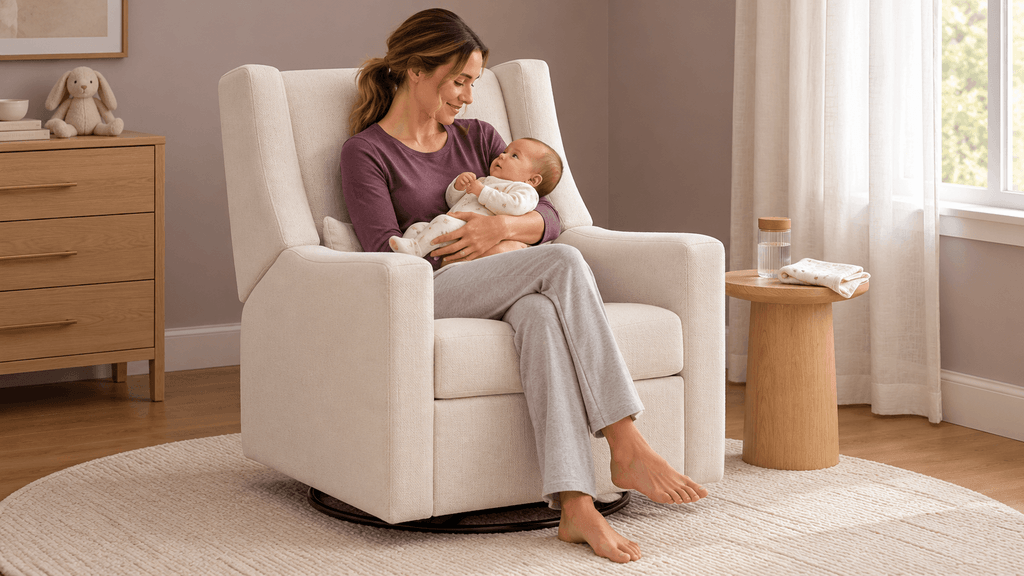
Kiwi is worth considering because shorter owners describe finding it comfortable even when its proportions are not an exact match. It has the highest and deepest published seat here, so its inclusion needs more explanation than simply calling it a popular nursery chair.
One 5′0″ owner chose Kiwi for its comfort over longer sitting sessions while acknowledging that it was large for her height. A 5′1″ owner liked it compared with other chairs she had tried, but said her feet just missed the floor and she needed a back pillow. Another owner around 5′3″ praised the comfort and condition of an older Kiwi.
Those accounts show the distinction between liking a chair and having ideal floor reach. They concern older chairs and show support Kiwi’s history with shorter users without proving that every current version will fit identically.
Kiwi makes more sense if you enjoy a cushioned, roomier chair and are willing to assess the seating position carefully. If sitting upright with both heels down is essential, its owner feedback gives you a reason to be cautious rather than reassured.
Also check your feeding setup. A comfortable chair can still leave you lifting your shoulders or leaning toward your baby if the support on your lap is wrong. Our guide to nursing pillows for petite moms compares options for bringing baby closer without relying on the chair alone.
Pros
- Specific shorter-owner accounts explain both comfort and compromises.
- Powered reclining avoids having to kick a manual footrest closed.
- Roomier seating may appeal to readers who dislike a closely fitted chair.
Cons
- Highest and deepest published seat of these three.
- Some shorter owners report imperfect floor reach.
- Older owner experiences cannot establish the fit of every current variant.
- Relevant production lots require recall-status checking.
Check the standard Babyletto Kiwi Electronic on Amazon
Check the Fit Before Committing to a Nursery Recliner
Start with a chair you already find comfortable. Measure from the floor to the top of the seat, then from the supporting back cushion to the front edge. Compare those measurements with the recliner’s published seat height and depth, not its overall height and depth. Soft cushions compress, and measuring methods vary, so use the numbers to narrow your choices rather than predict an exact fit.
When you can try a chair, sit fully back with your shoulders relaxed. Check whether your feet are supported and whether the seat edge presses behind your knees. Then consider the position you actually use for feeding, including your nursing pillow. You should not have to lean forward constantly just to reach your baby.
Test the controls and stand up with empty arms first. Return the footrest fully, check that you can reach the buttons without an awkward stretch, and notice whether you must scoot forward several times to get up. Keep children and pets clear of the mechanism and follow the manufacturer’s operating instructions.
A back cushion can reduce usable seat depth, and a stable footrest can support feet that do not reach the floor. Neither is automatically a satisfactory solution. A cushion can change your arm support, while a footrest can occupy the space you need to stand. If the arrangement still feels awkward, choose a different chair rather than buying accessories to keep correcting it.
Before ordering, check return costs, packaging requirements, collection arrangements, and who pays for shipping. This matters more than another minor feature when buying a heavy chair you cannot try first. Leave room for the full reclining movement and keep a clear route to your baby’s sleep space.
A recliner is a feeding and sitting chair, not a safe sleep space for you and your baby together. If you feel yourself becoming drowsy, place your baby on their back in a separate, firm, flat sleep space. Follow the American Academy of Pediatrics’ safe-sleep guidance.