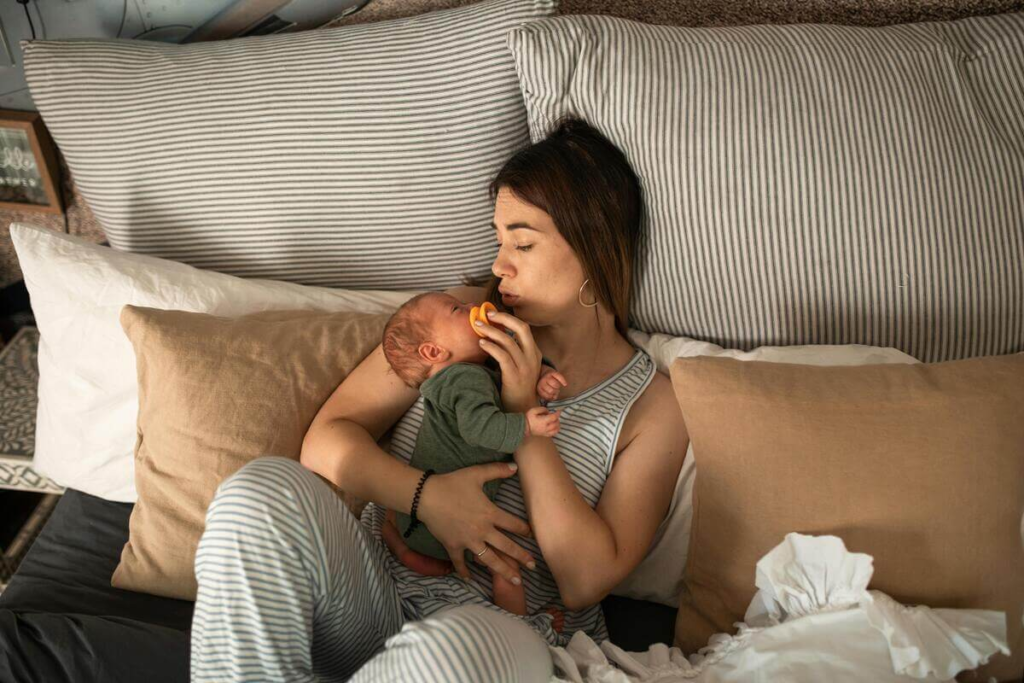
You already know the feeling. Someone tells you to sleep while the baby is sleeping and you lie down, but your eyes keep drifting toward the monitor. Or you hand your baby to your partner for twenty minutes and spend the whole time hovering just slightly out of reach. You cannot even shower calmly because you spend the whole time listening for every sound and checking in every few minutes.
You find yourself wondering why you feel like you have to watch your baby all the time, even when they are perfectly safe, even when someone else is right there, even when every rational part of you knows nothing is wrong.
It is exhausting not just physically, but mentally as well. Because your eyes and your attention never fully get to rest. And the harder you try to step back, the more uncomfortable it becomes.
The good news is that there is a reason your nervous system is operating this way. In many cases, it is linked to normal protective instincts, sleep deprivation, and sometimes postpartum anxiety or postpartum hypervigilance. Once you understand what is happening, the feeling often becomes much less frightening and easier to manage.
Why Do I Feel Like I Have to Watch My Baby All the Time
The need to keep your eyes on your baby is one of the most common aspects of early parenthood, and it happens because your brain has been rewired around a single priority since the moment your baby arrived.
Your brain now treats your baby’s safety as its most urgent and ongoing concern, above almost everything else. Your brain has learned, very quickly, that your baby needs you to stay alive. So your nervous system has decided that the safest strategy is to keep you watching. And therefore, constantly watching your baby becomes the default setting, because from your brain’s perspective, the moment you look away is the moment something could happen.
This is sometimes called postpartum hypervigilance, and it exists on a spectrum. For some mothers it is a background hum, a low level alertness that is always present but manageable. For others, it is louder and more consuming, making it genuinely difficult to focus on anything else for more than a few minutes at a time.
What This Constant Need to Watch Can Look Like
1. Repeatedly Checking the Monitor. It looks like sitting down to eat while your baby naps and realizing you have checked the monitor four times in the last three minutes. Not because anything alarming happened, but because you cannot stop watching, even when there is nothing to watch for.
2. Hovering when someone else holds the baby. Your partner, mother, or trusted relative, or caregiver is holding the baby, yet you still feel tense and unable to relax.
3. Listening for every tiny sound. Whether baby is asleep or awake, whether they are in your arms or across the room, whether you’re in the middle of a conversation you’re always listening. Even during sleep, part of your mind feels awake and listening.
4. Struggling to leave the room. You want to shower, eat, or rest, but walking away feels strangely difficult.
5. Feeling responsible for every outcome. It can feel like of you stop paying attention for one moment, something will go wrong and it will somehow be your fault. If you want to understand this endless pressure of responsibility during the early postpartum period, this article: Why Do I Feel Responsible For Everything That Could Go Wrong With My Baby? explains in detail.
Is This Normal New Parent Behavior or Postpartum Anxiety
Some extra alertness is common in early parenthood, especially in the first weeks after birth.
Many parents check on their baby often, sleep lightly, feel protective, need time to trust others helping, and feel more aware at night.
That alone, does not mean anything is wrong. However, if may be worth looking deeper if the urge to watch your baby is severely affecting your wellbeing.
Signs that may be linked to postpartum anxiety include:
- Being unable to sleep even when the baby is sleeping
- Constant fear something bad will happen
- Panic when someone else helps
- Intrusive worst-case thoughts
- Feeling unable to function normally
- Persistent tension in your body all day
If this sounds familiar, support can make a real difference.
Why It Feels So hard to Relax
Many mothers think, “if I could just calm down, I would.” The problem is that this reaction is not just logical, it is physical. Your brain has linked watching to safety so when you stop watching, your body interprets it as risk.
That is why even when your rational mind says the baby is fine, your chest may still feel tight or restless.
Furthermore, sleep deprivation can intensify this because when you are overtired, the brain becomes more sensitive to perceived threats and less able to settle itself.
What This Constant Watching Can Cost You
Postpartum hypervigilance is exhausting because you do not get recovery time between moments of alertness given that the alertness is continuous. Even sleep, when you get it, is often lighter than it used to be because some part of your brain is still listening out.
Over time, this level of sustained attention starts to affect other parts of your life. Conversations feel harder to stay in the present. Tasks that used to come easily now require more effort. Simple pleasures, a meal, a shower, a moment of quiet, become edged with guilt or unease rather than rest. This is because your nervous system is keeping watch so much that there is less left over for everything else.
How to Start Easing the Need to Watch Your Baby
The goal here is not to stop caring or to force yourself to be less attentive than feels natural. It is to very gradually show your brain that it is safe to reduce the intensity, even just a little, without anything going wrong.
1. Create a safe sleep environment
If your brain is watching because it does not feel confident that your baby is safe without your eyes on them, give it something concrete to rely on. A safe sleep setup following the recommended safe sleep guidelines is one of the best ways. When your nervous system has real evidence that the environment is safe, it becomes slightly easier to step back from the constant watching.
2. Practice small step-aways
Do not force huge separations immediately. Start with tiny moments like making tea, taking a shower, or stepping into another room for two minutes while your baby sleeps. Then let yourself notice that everything was fine when you returned. Repeat that enough times and your brain slowly starts to update its threat assessment. The evidence accumulates and the urge loosens slightly.
3. Name what is happening
When you notice you have checked the monitor for the fifth time in ten minutes, instead of feeling frustrated with yourself, try acknowledging it. “My nervous system is doing its alert thing again.” That small act of naming it creates just enough distance to take a breath rather than spiral.
4. Let others help in short windows
If handing over care feels hard, begin with 10-15 minutes rather than hours. That often feels manageable and helps retrain the belief that only you can keep the baby safe.
5. Protect your own sleep
Lack of sleep often amplifies new mom anxiety. Even one protected period of rest can noticeably lower the intensity.
When to Seek Support
If the need to watch is so consuming that it is preventing you from sleeping even when you have the chance, making it impossible to let anyone else care for your baby, or filling most of your waking hours with dread rather than presence, that is worth talking to a specialist about. Not because you’re failing as a mom, but because that level of sustained alertness deserves proper support.
In Conclusion
The need to watch your baby all the time is not a flaw in who you are. It is a nervous system that loves someone completely and has not yet learned that it is allowed to rest. That is something that can change, slowly and gently, with the right understanding and the right support.
It’s worth noting that constantly watching your baby does not actually make them safer beyond a certain point. A baby who is in a safe environment is not made safer by being watched every single minute. The watching, past a certain threshold, is for your nervous system, not for your baby. And your nervous system deserves some relief too.
You are allowed to look away. You are allowed to be in another room. You are allowed to rest. And rest is part of protecting your baby.
FAQ
Is it normal to feel like I need to watch my baby constantly?
Some increased alertness is common after birth. However, if it feels relentless or exhausting, it may be linked to postpartum anxiety or hypervigilance.
Why can’t I relax when someone else is holding my baby?
Your nervous system may still believe that only your attention keeps the baby safe, while someone else might miss something important. This is despite the fact that logically, you trust this other person.
Is checking the baby monitor all the time anxiety?
Sometimes. Frequent checking can become a reassurance habit when anxiety is present.
When does the need to keep watching my baby stop?
For many mothers, it eases as recovery improves, sleep returns, and confidence grows. If severe, support can speed up improvement.
Can postpartum anxiety cause hypervigilance?
Yes. Many mothers with postpartum anxiety describe feeling unable to switch off or stop watching their baby.