A baby carrier can be adjustable and still feel too big. The shoulder padding might wrap under your arms, the waistband might fill the space between your ribs and hips, or you might run out of adjustment before your baby feels close and supported.
If you’re 4′10″, a recommendation from someone 5′4″ is useful context not proof that the same carrier will feel right on you. And being short does not necessarily mean having a small waist, narrow shoulders, or a small baby.
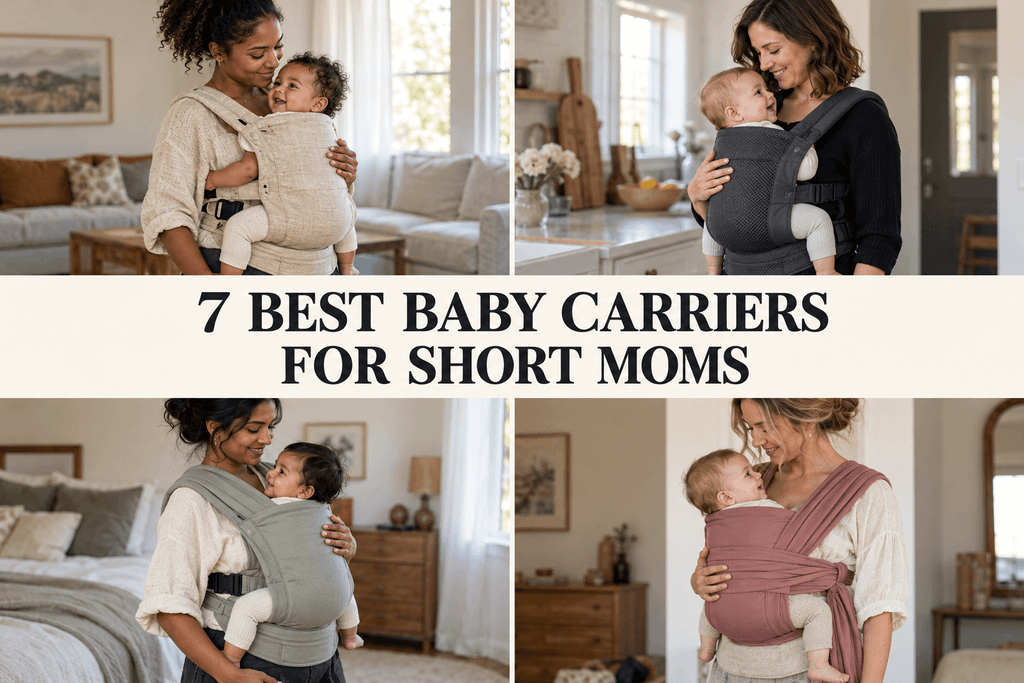
The best baby carrier for short moms is the one that fits both your proportions and your baby’s current stage. These seven options offer different ways to get there, from soft newborn carriers to more structured designs for continued use as your baby grows.
This post contains affiliate links. If you buy through these links, we may earn a commission at no extra cost to you. As an Amazon Associate, we earn from qualifying purchases.
How We Chose These Baby Carriers
This is a research-based comparison, not a hands-on test by our team. We compared manufacturer guidance, identifiable Amazon US listings, independent reviews, and owner experiences that described the wearer’s height or a specific fit problem.
Our selection considers shoulder adjustment, waistband construction, bulk, fastening access, and the baby’s weight and developmental requirements. We included different designs rather than assume every shorter mom needs the smallest or least padded carrier.
When we mention 5′0″ and under or around 5′1″–5′3″, those are shopping starting points, not manufacturer-approved height ranges. Older owner reports may describe earlier versions, so they support considering a design rather than establish the fit of every current model.
The weight ranges below do not override the instructions supplied with your carrier. Meet its height, weight, developmental, and positioning requirements together; reaching the minimum weight alone does not establish a safe fit.
The Shortlist: Which Carrier Should You Compare First?
- Beco Gemini Cool Mesh: Best for smaller moms wanting a structured carrier with crossable straps.
- Happy Baby Original: Best for short torsos seeking a lightweight alternative to a thick, structured waistband.
- Ergobaby Embrace: Best for soft newborn carrying without tying a full wrap.
- BabyBjörn Mini: Best for frequent, short carrying sessions in the early months.
- Tula Original / Free-to-Grow: Best for adjustable inward-facing and back carrying as baby grows.
- BabyBjörn Harmony: Best for parents who prioritize padding and front-access adjustments.
- Boba Baby Wrap Carrier: Best for an adjustable wrap-style alternative.
These labels describe the reason to consider each carrier not a guarantee of fit or comfort.
1. Beco Gemini Cool Mesh-Best for Smaller Moms
Key Specs
- Carrier Type: Structured buckle carrier with a mesh panel.
- Baby Weight Range: 7–35 lb.
- Carry Options: Front inward, front outward, hip, and back, subject to the instructions for each position.
- Adult Sizing: Manufacturer describes Gemini fit as XS–XXL; confirm the exact version’s adjustment range.
- Fastening: Waist buckle and shoulder buckles; H or crossed-strap configuration.
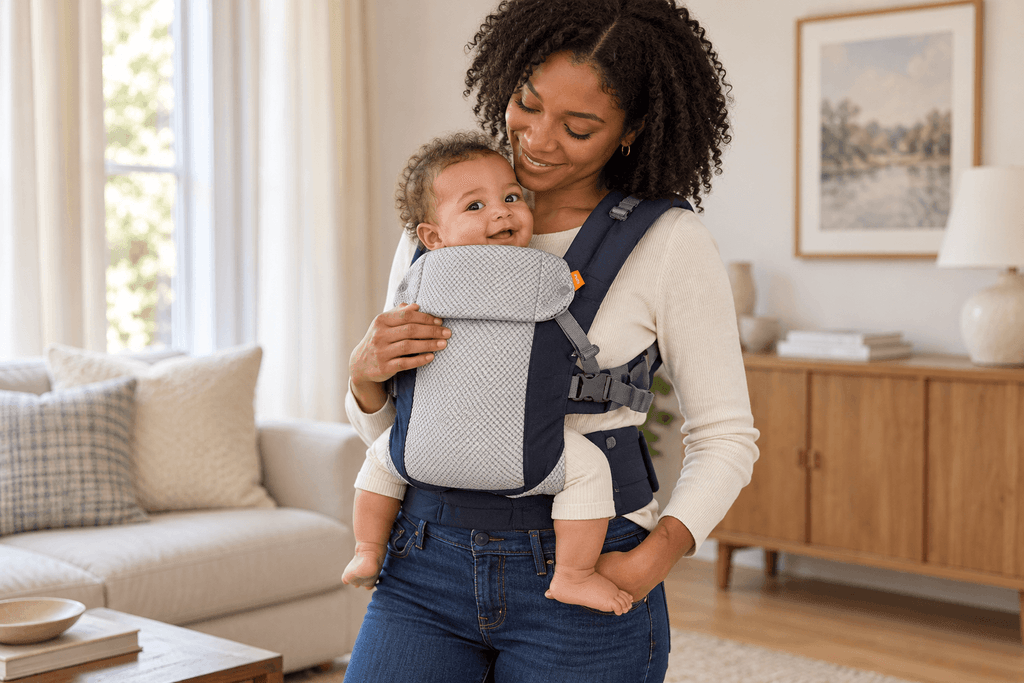
Gemini is one of the first designs I would compare for a mom around 4′10″–5′0″ who wants a buckle carrier rather than a wrap. Its useful feature is the choice of H or crossed shoulder straps: you have another way to position the straps if one arrangement does not sit comfortably on your shoulders.
A 4′11″ owner described earlier Geminis fitting her small frame and babies well, highlighting the strap width and padding. A sling-library specialist also describes the design as popular with petite parents who want something less bulky.
Pros
- Crossable straps offer an alternative to the H configuration.
- Mesh panel provides a more ventilated option than a fully covered fabric panel.
- Adjustable seat and headrest, with no separate infant insert specified for this model.
Cons
- Two seat-width settings provide less gradual width adjustment than some alternatives.
- Padded waistband and straps can still feel substantial on a very small torso.
Check Beco Gemini Cool Mesh on Amazon
2. Happy Baby Original-Best for Moms With Short Torsos
Key Specs
- Carrier Type: Soft structured buckle carrier with an apron-style waistband.
- Baby Weight Range: 7–45 lb.
- Carry Options: Front inward and back; follow the manufacturer’s readiness requirements.
- Adult Sizing: Manufacturer lists approximately 23–54 inches at the waist.
- Fastening: Waist buckle, shoulder adjustments, and connecting chest/back strap.
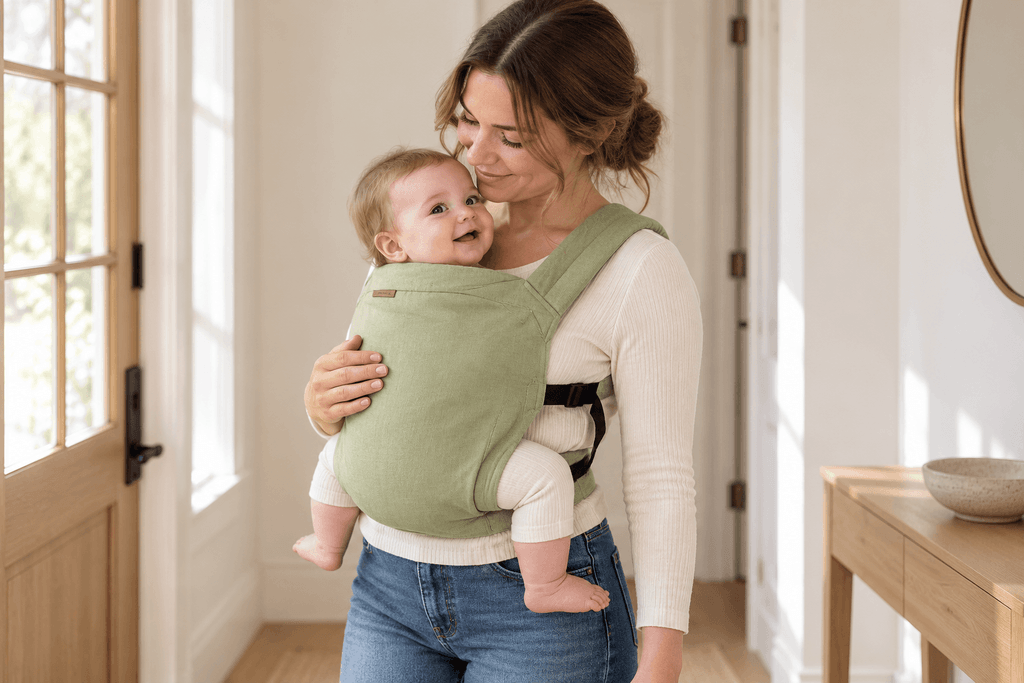
Happy Baby Original deserves attention if the waistband, not your overall height is what makes other carriers uncomfortable. Its apron-style construction offers a different arrangement from a broad, heavily padded belt.
In a petite-parent discussion, wearers at 4′8″ and 5′0″ reported liking Happy Baby carriers. A 5′1″ plus-size wearer specifically preferred the apron-style waistband for her short torso. That last example matters: short-torso comfort is not exclusively a slim-parent issue.
The compromise is less substantial padding and no outward-facing mode. You are choosing a lighter, simpler arrangement. With a small baby, follow the manufacturer’s adjustment guidance so the panel does not rise too high around the face.
Pros
- Less bulky waistband construction to compare if padded belts crowd your torso.
- Compact design that folds into a diaper bag.
- Adjustable baby seat width and a wider published weight range than the newborn-focused options.
Cons
- No outward-facing carry.
- Connecting-strap access and small-baby positioning may take practice.
Check Happy Baby Original on Amazon
3. Ergobaby Embrace-Best Soft Newborn Carrier
Key Specs
- Carrier Type: Soft newborn-focused buckle carrier.
- Baby Weight Range: 7–25 lb.
- Carry Options: Front inward and, when permitted by the manual’s readiness requirements, front outward.
- Adult Sizing: Adjustable; published waistband range approximately 22–54 inches.
- Fastening: Waist buckle and crossed shoulder straps with side buckles.
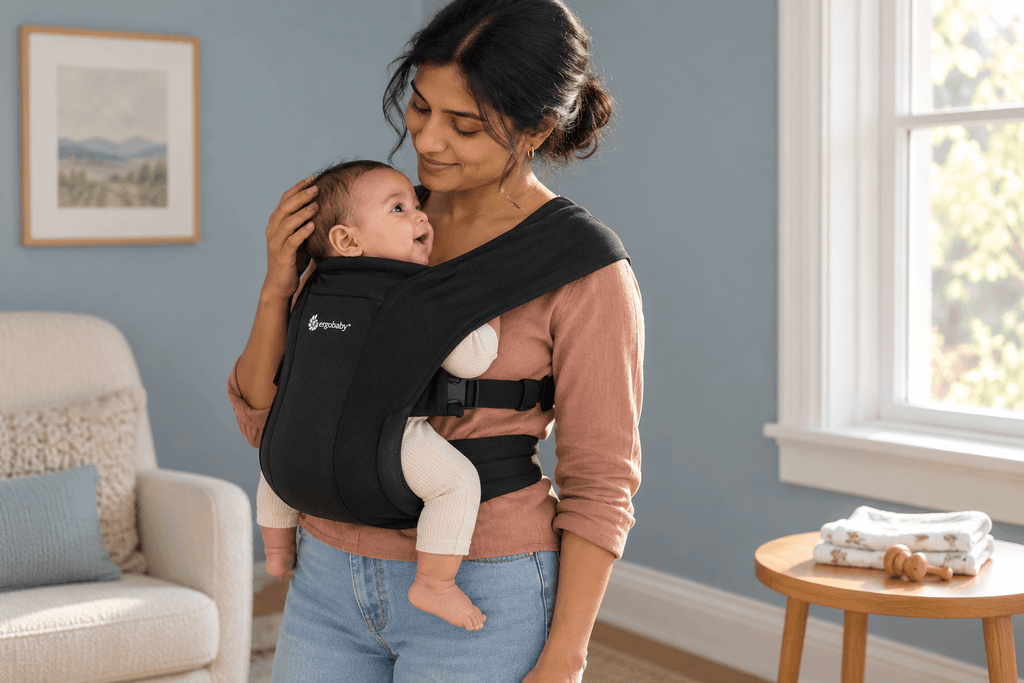
Embrace offers a useful middle ground between a wrap and a larger structured carrier. The soft construction and spreadable crossed straps make it worth comparing if bulky shoulder padding overwhelms your frame.
For a mom 5′0″ or under, that reduced structure may be more appealing than a carrier loaded with extra features. Someone around 5′1″–5′3″ may choose it for the same reason: a softer early-month carrier rather than maximum carrying longevity.
Embrace is designed for the early months, with a manufacturer-stated weight range of 7–25 lb. Its soft construction may become less comfortable as your baby gets heavier, even before reaching the upper limit.
Pros
- Soft construction and crossed straps without a long fabric wrap to tie.
- Side fastening avoids a connecting buckle between the shoulder blades.
- Compact enough to keep nearby for short everyday carries.
Cons
- Lower weight limit than several other finalists.
- May feel less supportive as the baby becomes heavier, even before the stated limit.
Choose it as an early-stage carrier you want to use now, rather than buy it expecting the same support and useful life as a larger structured model.
Check Ergobaby Embrace on Amazon
4. BabyBjörn Mini-Best for Short Newborn Carrying Sessions
Key Specs
- Carrier Type: Compact newborn-focused harness carrier.
- Baby Weight Range: 7–24 lb under current US manufacturer guidance; baby height 21–30 inches.
- Carry Options: Front inward and front outward when the baby meets the required age and head-control criteria.
- Adult Sizing: Current product guidance describes an adjustable XS–XL fit.
- Fastening: Adjustable shoulder harness and front attachment points; no waist belt.
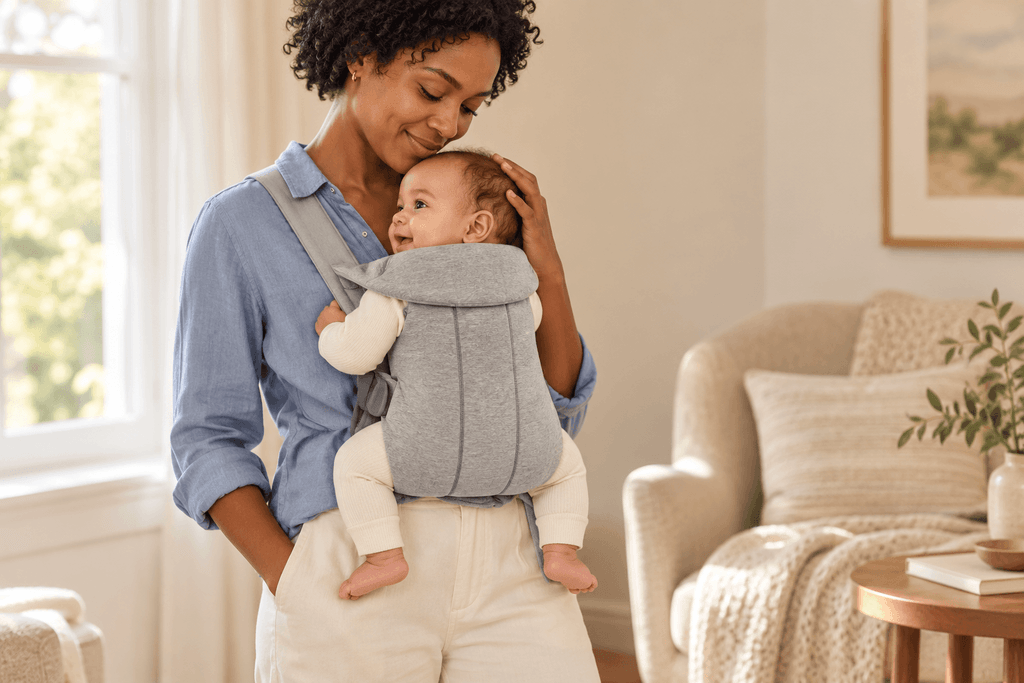
Mini offers a different solution to waistband discomfort: it does not have one. If a belt repeatedly presses into your ribs or crowds a short torso, that is a meaningful reason to compare it with Embrace rather than treat them as interchangeable newborn carriers.
BabyBjörn Mini has a removable front section, so you can lift your baby out without taking off the entire harness. That makes it a practical option for frequent, short carrying sessions in the early months.
The trade-off is weight distribution. There is no waist belt to share the load in the same way as the other buckle carriers here. Consider it for shorter sessions rather than assume that compactness will make long carries comfortable as the baby grows.
Pros
- No waistband to fit into the space between your ribs and hips.
- Compact design with front-access fastening.
- Front section unfastens for taking the baby out.
Cons
- No waistband to distribute some of the load away from the shoulders.
- Limited baby size range compared with the longer-use options.
Check BabyBjörn Mini on Amazon
5. Tula Original / Free-to-Grow-Best for Adjustable Inward and Back Carrying
Key Specs
- Carrier Type: Structured buckle carrier with an adjustable baby panel.
- Baby Weight Range: 7–45 lb.
- Carry Options: Front inward and back, subject to the instructions for each position.
- Adult Sizing: Free-to-Grow guidance lists an approximately 27–57-inch waistband; confirm the selected version.
- Fastening: Waist buckle, adjustable shoulder straps, and connecting chest/back buckle.
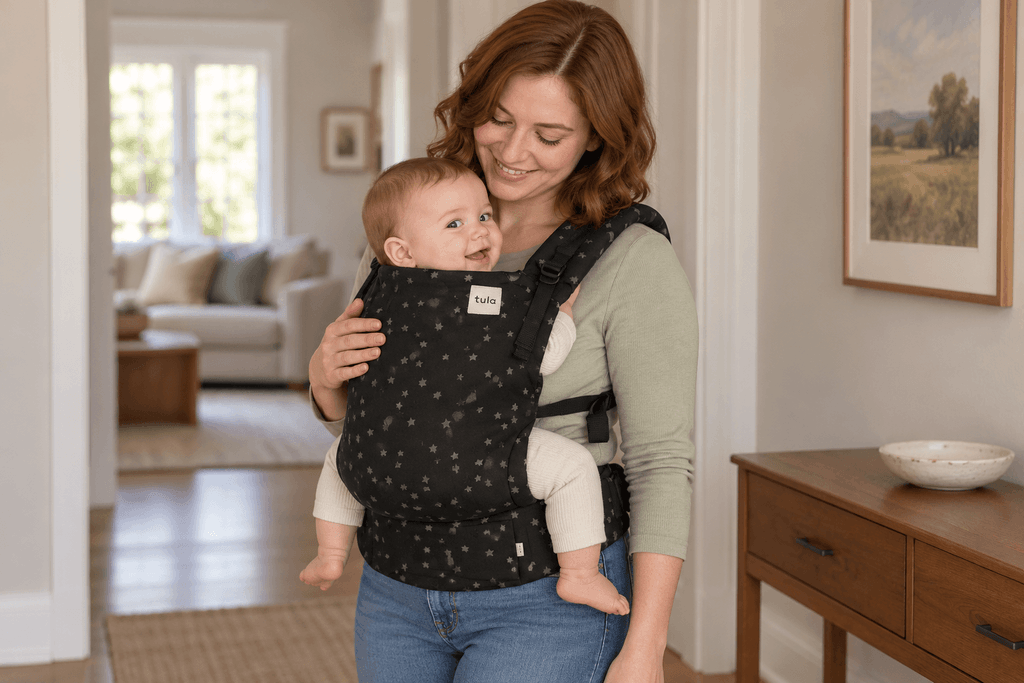
Tula now markets this design as Original, formerly Free-to-Grow. Do not confuse it with older recommendations for the Tula Standard, which has different small-baby requirements.
Its adjustable panel makes it worth comparing if you want one carrier to accommodate different stages without purchasing a separate infant insert. Independent petite-parent reviews describe Free-to-Grow as a relatively straightforward option.
However, I would not automatically put it ahead of Gemini or Happy Baby for someone at 5’0″ or below. A 4′10″ owner seeking a fit check reported the padded straps wrapping under her arms. That does not prove poor fit, but it identifies a useful checkpoint for the smallest wearers.
Around 5′1″–5′3″, it remains a sensible comparison if the waistband and padded strap sections match your proportions.
Pros
- Adjustable panel width and height to accommodate the baby’s growth.
- No separate infant insert required for the Free-to-Grow design when the baby fits correctly.
- Inward-facing front and back options without paying for an outward-facing feature you may not want.
Cons
- Minimum waistband fit and padded strap length need attention on very small frames.
- Reaching the connecting buckle may be awkward; no outward-facing mode.
Choose it for the adjustable panel and carrying arrangement, not simply because it appears on many petite-parent lists.
Check Tula Original / Free-to-Grow on Amazon
6. BabyBjörn Harmony-Best for Padding and Front-Access Adjustments
Key Specs
- Carrier Type: Structured buckle carrier with padded back and waist support.
- Baby Weight Range: 7–40 lb under current US guidance; baby height 21–39 inches.
- Carry Options: Front inward, front outward, and back; newborn and older-baby settings have separate requirements.
- Adult Sizing: Manufacturer lists XS–XXL and an approximately 21–63-inch waistband range.
- Fastening: Adjustable harness with front-access attachment points and waist fastening.
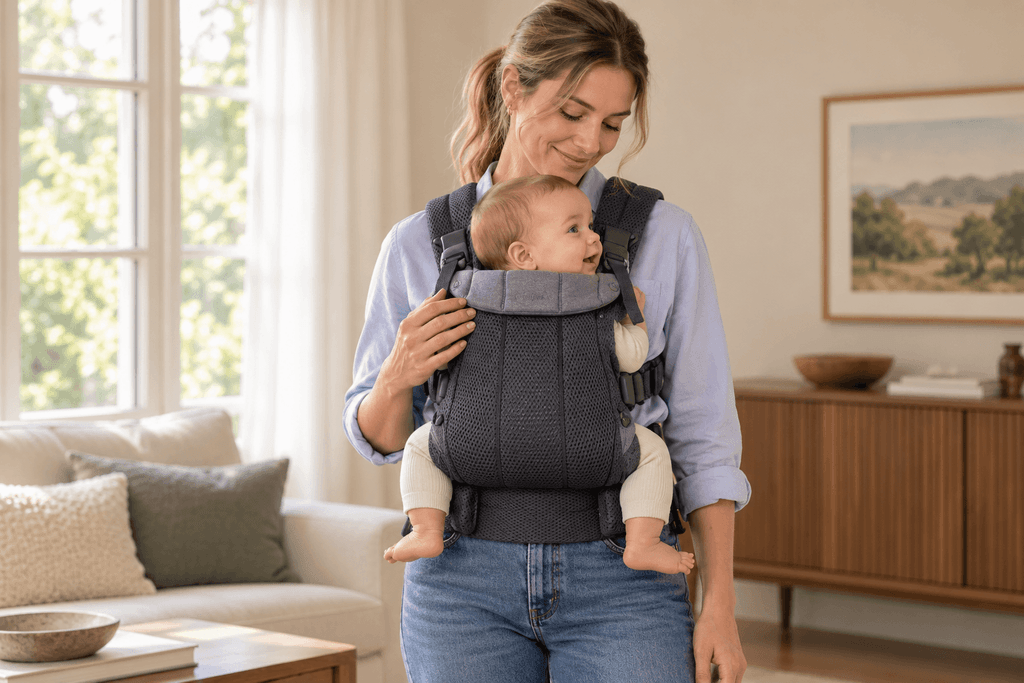
Less bulk is not every short mom’s priority. If a thin belt presses uncomfortably against your body, you may prefer padding even though it takes up more space.
Harmony earns its place as that alternative. A petite reviewer at Mama’s Buzz describes finding its padded waistband comfortable and its front adjustments easier to access than a buckle behind the shoulders. BabyBjörn’s published adjustment range also makes it worth comparing for a narrow waist.
That range does not establish short-torso comfort. At 5’0″ and below, check whether the padded belt and shoulder sections sit comfortably together. A mom at 5′3″ with a short torso should make the same check.
Pros
- Padded waistband, shoulder straps, and back support.
- Front-access attachments reduce the need to reach between the shoulder blades.
- Wider published baby weight range than Mini or Embrace under US guidance.
Cons
- More structure and a higher price than simpler early-stage options.
- Padding that feels supportive to one wearer may feel crowded on another.
Harmony is worth the comparison when cushioning and fastening access solve your problem. It is not the default choice just because it has more features.
Check BabyBjörn Harmony on Amazon
7. Boba Baby Wrap — Best Traditional Wrap
Key Specs
- Carrier Type: Stretchy wrap made from a cotton-spandex blend.
- Baby Weight Range: 7–35 lb; Boba says it works best up to approximately 20 lb.
- Carry Options: Front inward-facing carrying.
- Adult Sizing: One size; approximately 5.5 yards of fabric tied to fit the wearer.
- Fastening: Wrap-and-tie design without buckles.
A structured carrier can look adjustable and still leave its waistband loose or its shoulder straps awkwardly positioned. The Boba wrap takes a different approach: you wrap and tie the fabric around your body, adjusting the tension rather than relying on fixed straps or a padded belt.
That makes it worth considering for short moms, particularly those who struggle to tighten buckle carriers sufficiently. It also accommodates different body shapes; being short does not mean you need the smallest clothing size. Your height alone cannot guarantee a good fit, but this design gives you another way to achieve one.
The soft fabric spreads across your shoulders and back, creating a close hold without a rigid waistband crowding a short torso. Alongside the buckle carriers in this roundup, it offers a distinct choice for parents who prefer the feel of a traditional wrap.
The compromise is learning to use it. You must establish the correct tension and follow the wrapping instructions each time. At approximately 5.5 yards long, there is also plenty of fabric to handle, especially on a smaller frame. If managing long fabric tails sounds frustrating, the Ergobaby Embrace offers a simpler fastening routine.
Treat the Boba Classic primarily as an early-months purchase. Its maximum weight is 35 lb, but Boba’s own guidance says it works best up to approximately 20 lb. Choose it for close, comfortable carrying now rather than assuming its maximum rating means it will remain your preferred carrier through toddlerhood.

Pros
- Tie-to-fit design offers an alternative when structured carriers do not tighten sufficiently.
- Soft fabric and no rigid waistband to crowd a short torso.
- Can be retied for caregivers with different body shapes.
- Adds a traditional wrap option alongside the buckle carriers in this guide.
Cons
- Requires practice to achieve consistent wrapping and tension.
- Long fabric tails can be cumbersome on smaller frames.
- Better suited to early-months use than shoppers might assume from the 35 lb maximum.
- No outward-facing or back-carry option.
Check Boba Baby Wrap on Amazon
How to Choose a Carrier When You’re Short
Identify Which Part Feels Too Big
If you are 5′0″ or under, start by checking the padded shoulder sections and the amount of space the waistband occupies. Gemini and Happy Baby are useful first comparisons for continued use, while Embrace and Mini address the early months differently.
If you are around 5′1″–5′3″, you may have more room for a structured carrier, but a short torso or narrow shoulders can still make one uncomfortable. Tula and Harmony deserve consideration alongside the lighter options, not automatic preference.
A short torso can occur at either height. Notice whether the belt presses into your ribs, the shoulder padding bunches under your arms, or tightening one area makes another uncomfortable. Those observations are more useful than a “petite-friendly” label.
Measure Where the Belt Actually Needs to Sit
Do not compare waistband measurements only with your jeans size. Follow the model’s instructions for positioning the carrier with your baby’s current size, then measure around your body at that level.
Check both ends of the adjustment range. A generous maximum tells you little about how tightly the carrier adjusts. Likewise, a narrow minimum does not prove the padding will suit your torso.
Use the manufacturer’s strap keepers or approved method to manage loose webbing. Do not cut straps or modify buckles to make a carrier smaller.
Match the Purchase to Your Baby’s Stage
A soft carrier you enjoy using with a small baby can be a good purchase even if you later change carriers. It is equally reasonable to prioritize a more adjustable structured design from the beginning.
The useful question is not “Which carrier has the highest weight limit?” It is “Which one supports my baby’s current size and feels comfortable on my body?” Panel height, seat width, head support, and developmental readiness matter alongside weight.
Check Whether You Can Fasten It Yourself
Watch the instructions for the exact carrier before buying. Consider whether you can reach its connecting buckle, whether you prefer crossing straps, and whether adjusting between you and a partner looks manageable.
A carrier that fits both adults still requires adjustment between wearers. If possible, try one through a retailer or sling library. Check the return terms, including whether a tried-on carrier can be returned, and use manufacturer or qualified babywearing support if the fit is unclear.
A Brief Safety Check Before Every Carry
Your baby’s face must remain visible, with the nose and mouth unobstructed and the chin away from the chest. Keep the baby close and supported in the position required by the carrier’s instructions. The US Consumer Product Safety Commission emphasizes frequent checks of breathing and positioning, particularly in slings.
Do not use outward-facing or back positions simply because they appear in a product description. Follow that model’s minimum age, head-control, height, and other readiness requirements. Never allow outward-facing sleep.
Seek advice from your baby’s clinician before use if your baby was premature, has low birth weight, breathing problems, or a medical condition that could affect positioning. A carrier is not a substitute for an approved infant sleep space; if your baby falls asleep, move them to a firm, flat sleep surface on their back as soon as possible.