
You walk into the room where your baby is sleeping and your eyes go straight to their chest before you have even consciously decided to look. You are in the middle of a conversation but some part of your brain is still listening for a strange sound from the nursery. You finally sit down, everything is fine, and within minutes your brain is scanning again.
If you have been wondering why your brain keeps scanning for danger after having a baby even when there is nothing to be afraid of, there is a reason. And for many new moms, it has far less to do with “overthinking” than people assume.
What you are caught in is something I call the Maternal Safety Loop. It is a repeating cycle that quietly runs underneath postpartum anxiety, hypervigilance, constant checking, and the feeling that you can never fully let your guard down.
The loop usually starts with love and protection. But over time, it can become exhausting to live inside.
Understanding the loop does not instantly switch the anxiety off, but it does give you a clearer picture of why the fear feels so repetitive and hard to escape.
Your Brain Was Given a New Job the Moment Your Baby Arrived
From the moment your baby entered the world, your nervous system reorganised itself around a single priority: keeping them safe.
Not as a conscious choice, but as a biological shift. Research shows that the postpartum brain becomes more sensitive to potential threats, more emotionally responsive, and more alert to changes in the environment. Your nervous system starts operating differently because, suddenly, someone entirely dependent on you exists.
That is why postpartum hypervigilance can feel so intense. The scanning you cannot seem to stop is part of that design.
Your brain is not malfunctioning because it keeps checking, listening, scanning, or monitoring. It is responding to a completely new level of responsibility.
The problem is not the protective instinct itself. The problem is that the instinct can become self-reinforcing. Instead of standing down once the danger passes, your nervous system keeps acting as though the danger could return at any second.
What the Maternal Safety Loop Actually Is
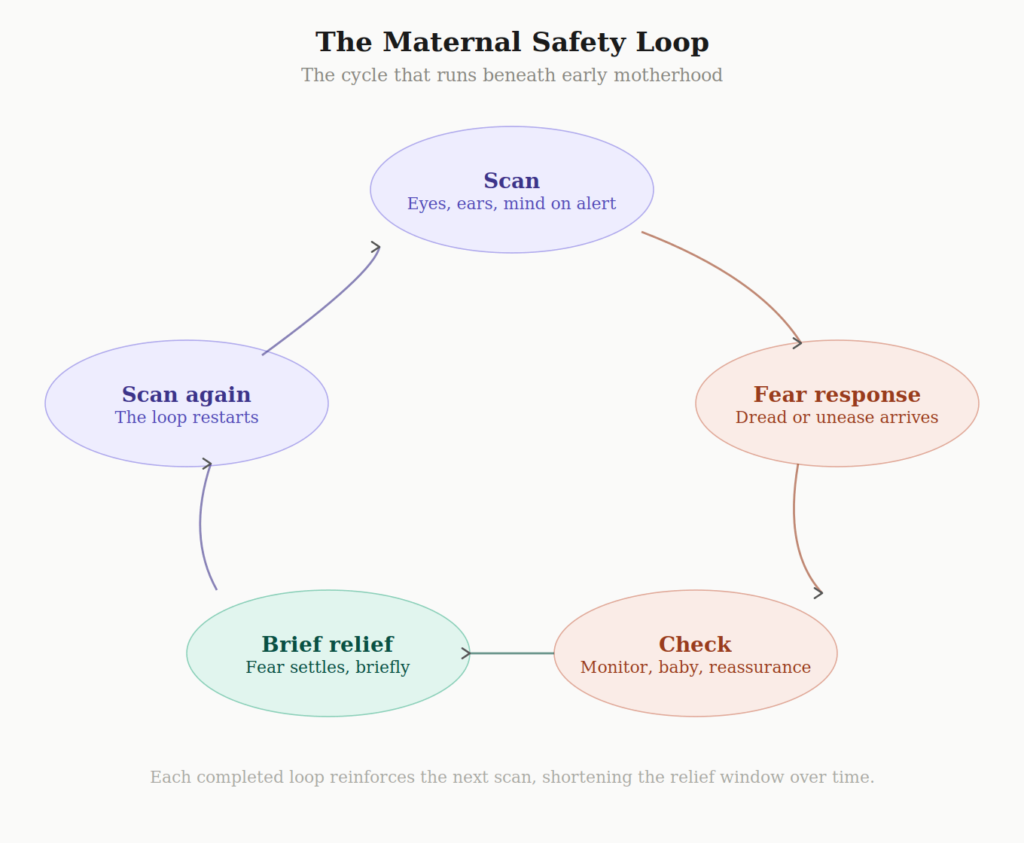
The Maternal Safety Loop is a five-stage cycle that most new mothers move through dozens of times a day without realizing it is happening.
It usually follows the same pattern beginning with a scan, a rapid, largely automatic sweep of the environment for anything that could signal danger to the baby. The scan might be visual, checking the baby’s chest for movement, or auditory, listening for changes in breathing. It might be a quick mental review of everything that happened in the last hour, looking for something that could have gone wrong.
The scan triggers a fear response. Not always a dramatic one. Sometimes it is a sharp spike of dread. Other times it is a low hum of unease, a vague sense that something needs to be confirmed.
Either way, the fear creates an urgent pull toward the next stage: checking. You look at the monitor. Or you walk to the crib. You ask your partner if the baby seemed okay. You replay the last feed in your mind to confirm nothing was wrong.
The check brings relief. Brief, real, and genuine.
For a moment, the fear settles. Everything is fine. You have confirmed it yourself. And then, often within minutes, the scan begins again.
That is the Maternal Safety Loop. Scan, fear, check, relief, scan again.
This is why many new mothers feel trapped in constant checking postpartum. The relief never lasts long enough for your nervous system to fully stand down.
If your checking centers around breathing or sleep, Why Do I Keep Checking If My Baby Is Breathing at Night? Goes deeper into why nighttime monitoring becomes so consuming for many moms.
Why This Feels So Convincing in the moment
One of the hardest parts of postpartum anxiety is that the fear feels responsible.
The scanning feels productive. The checking feels protective, and the vigilance feels necessary. So, every time nothing bad happens, your brain quietly treats that as proof that the system is working.
You stayed alert. Nothing happened. You checked the monitor repeatedly. Your baby was fine. You replayed every detail from the day. Everything stayed safe. Therefore, your nervous system connects those dots very quickly.
That is also why many mothers begin feeling personally responsible for preventing every possible outcome, even the ones completely outside of their control. Why Do I Feel Responsible for Everything That Could Go Wrong with My Baby? explores why love, fear, and responsibility become tangled together in the postpartum period.
The difficult part is that with each loop that the brain completes it does not learn: “Nothing bad was happening therefore scanning is unnecessary.” Instead, it learns: “Checking is what prevented something bad from happening.” Therefore, you must keep scanning.
Over time, that lesson is reinforced and it keeps prompting you to seek reassurance. Consequently, the loop stays alive.
Why the Loop Gets Stronger Over Time
Most mothers assume the fear naturally fades with time. Sometimes it does. But when the loop keeps repeating for weeks or months without interruption, the opposite can happen.
The scans become faster. The checking becomes more automatic. The relief window gets shorter.
Eventually, your nervous system stops waiting for actual danger before sounding the alarm. It starts operating as though constant alertness is simply the safest permanent setting.
This is why reassurance and well-meaning postpartum advice like “just try to relax” or “stop overthinking” usually feels useless when you are deep in new mom anxiety. From outside, the fear may look excessive. But from the inside, relaxing the scan feels genuinely dangerous. The brain is not willing to take that risk, and no amount of reasoning will override a protective system that is running this deep.
If the constant “background hum” of fear feels familiar, Why Does Fear Feel Constant? Why New Moms Can’t Switch Off the Worry explains why postpartum anxiety often stops feeling temporary and starts feeling permanent.
What Each Stage of the Loop Actually Feels Like from the Inside
It feels like waking up already tense before your feet even touch the floor. Before your eyes fully open, some part of your brain is already checking whether the baby is breathing, whether the room is too quiet, or whether something feels different.
It feels like sitting down to eat while monitor is beside you, only to realize you have looked at it six times in the last few minutes without even noticing.
It feels like finally getting a calm moment and immediately becoming suspicious of it. The quiet itself starts to feel uncomfortable, almost like peace is simply the space before something bad happens.
For some mothers, the alertness becomes so strong that it feels impossible to stop watching the baby altogether, even during objectively safe moments. Why Do I Feel Like I Have to Watch My Baby All the Time? explores why your nervous system can become locked into that constant state of monitoring.
And perhaps the most isolating of all, it feels incredibly difficult to explain to people who have never experienced it themselves. From the outside, you may look perfectly functional. Internally, your nervous system never fully powers down.
That level of sustained alertness drains people slowly.
How to Start Interrupting the Loop
You do not break the postpartum anxiety cycle by forcing yourself to stop caring. The goal is not to become less attentive. The goal is to help your nervous system to learn that it does not need to operate at maximum alertness very second of the day.
The first step is learning to recognize the loop while it is happening.
At the scan stage, it’s important that you simply name it. “My brain is scanning again.” Not suppress it, not argue with it, just notice it. That act of naming creates just enough distance to take a breath before the fear response builds. It does not stop the scan, but it slows the momentum slightly.
At the checking stage, try delaying reassurance by just a minute or two before acting on the urge. Not an indefinite delay. Not in a harsh or forceful way. This is not about proving that checking is unnecessary. It is about showing your brain, slowly and gently, that the fear does not require an immediate response. The pause interrupts the reinforcement cycle without fighting the instinct directly.
At the relief stage, try to extend it deliberately. When the check confirms everything is fine, pause there. Notice the relief instead of letting it pass through unacknowledged. Name it. Your baby is safe right now. Stay with that for a moment longer than feels natural, instead of immediately scanning for the next possible threat.
Your brain needs repeated experiences of safety too, not just repeated experiences of vigilance.
When to Seek Support
If the loop has become so intense that it is affecting your sleep, your relationships, ability to leave your baby with someone else, or your ability to enjoy your daily life, it is worth talking to someone who understands postpartum hypervigilance and anxiety specifically.
Reaching that point is not failure. It simply means the loop has been running long enough that it needs more than awareness to slow down.
Final Thoughts
The Maternal Safety Loop begins from a deeply human place: love, protection and responsibility
Your brain is trying to keep your baby alive in the best way it knows how. The problem is that somewhere along the way, the scanning stopped being temporary and became constant. That does not mean you will feel this way forever.
A nervous system can relearn safety. The loop can slow down. The relief can last longer. And eventually, your brain can stop treating every quiet moment like a potential emergency.
If the loop mainly shows up as intrusive “what-if” thoughts or vivid worst-case scenarios, Why Do I Imagine Worst-Case Scenarios About My Baby? explores why your brain keeps mentally rehearsing danger even when everything is fine.
And if you are still trying to understand where this level of fear came from in the first place, the post Why Am I Scared Something Will Happen to My Baby looks at the deeper roots of postpartum fear and hypervigilance in early motherhood.