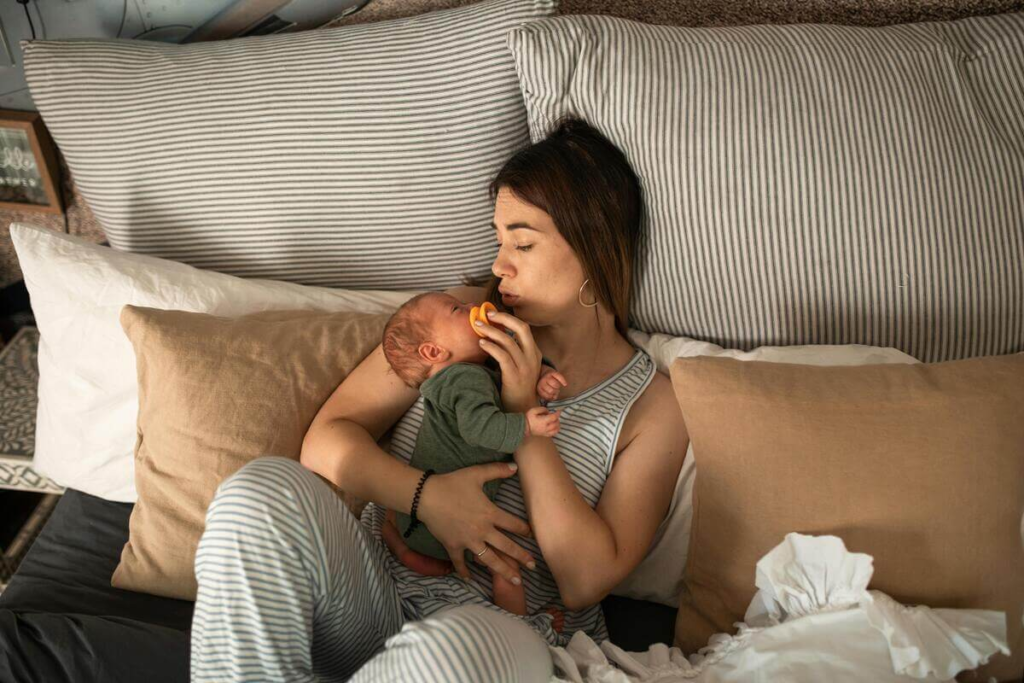
One minute your baby is sleeping peacefully beside you, and the next your brain is whispering, what if something is wrong?
So you lean over the crib once again and watch for their chest to rise. Maybe you touch them lightly just to be sure. Then five minutes later, you do it again.
If you keep wondering why you feel so scared something will happen to your baby, even when they are perfectly safe, you are not alone. This is one of the most common experiences in motherhood, especially in first-time moms.
Whereas some kind of fear is a normal part of becoming a parent, constant fear that becomes physical and impossible to shake may be more than ordinary new-mom nerves.
Sometimes this kind of fear is part of postpartum anxiety, where your nervous system stays stuck in protection mode and treats everyday moments like emergencies.
What This Fear Looks Like in Daily Life
This fear does not always look like obvious panic. Sometimes it can look like:
- Watching your baby sleep instead of sleeping yourself.
- Checking their breathing over and over
- Feeling unable to relax when someone else holds them
- Mentally replaying worst-case scenarios about your baby while doing ordinary tasks
- Feeling on edge during walks, car rides, or bath time
- Avoiding certain activities because they feel “too risky”
For many new moms, it feels like a constant hum of dread in the background even when nothing is wrong. Your body still somehow feels like its bracing for impact.
Why You Feel So Scared Something Will Happen to Your Baby(The Biology Behind It)
The reason why this fear feels so overwhelming after birth is because your body and brain go through massive biological changes in the postpartum period that affect how your bain processes safety.
Hormones shift rapidly, sleep becomes inconsistent, and at the same time your brain becomes highly tuned to your baby’s safety. Researchers have found that the maternal brain becomes more sensitive to threat detection after birth, which helps parents stay alert to danger.
While that heightened awareness is useful in moderation, for some mothers, that protective instinct gets amplified into constant fear. So instead of noticing potential risks, the brain starts scanning for danger all day long and treats normal uncertainty as if something terrible is always about to happen.
That is why postpartum anxiety can make you feel like disaster is always one step away, even when your baby is healthy and safe.
Why This Fear Feels So Hard to Control
One of the most frustrating parts of this experience is that reassurance rarely lasts.
You check the baby and feel better. You listen to their breathing and you calm down because you tell yourself everything is fine. But then, the fear comes back again.
This happens because your brain starts learning a pattern: checking equals relief, that reassurance is safety.
And so every time you check the monitor, or the baby to seek proof that everything is okay, your nervous system learns, “we survived because we checked”. So instead of calming down permanently, your brain becomes even more convinced that constant checking is necessary.
As a result, many moms find themselves stuck in a cycle of fear, checking, relief, and fear again.
Why This Is Not Your Fault (Even If It Feels Like It Is)
Many first-time moms quietly start blaming themselves. You might think, “I should be enjoying motherhood more,” why can’t I just relax?” “Something must be wrong with me.”
But it has nothing to do with your character, rather, it is your nervous system that is under strain.
When your body is sleep-deprived, hormonally shifting, and on top pf that, responsible for a newborn, your emotional regulation naturally weakens. That does not make you incapable, it makes you human and those feelings of fear do not in any way mean you are failing as a mother. It means your system is trying too hard to protect something you love.
Why People Around You May Not Notice
One of the hardest parts is that you can look completely fine on the outside. People see you getting things done and just assume you’re doing okay. They see a clean baby and a functioning house, so they don’t realize you may be dealing with constant scanning, mental exhaustion, and invisible panic loops.
This mismatch is why many moms feel misunderstood because the “outside” does not reflect their internal experience. And it’s for that reason that people often don’t realize how much support you actually need. Speaking up about the quiet stress helps them understand that you need more support.
When Does Normal New- Mom Worry Become Something More?
Every mom worries. You many double-check the monitor, you may feel nervous on your first outing alone with baby, or briefly panic over a strange noise or cough. That is all normal.
However, what is not normal is when the fear begins running your entire day. Your fear may be crossing into postpartum anxiety if:
- You cannot stop checking your baby even when you know they are fine
- You feel unable to sleep because your brain won’t shut down
- You avoid letting others help because you do not trust anyone else
- You constantly imagine accidents, illness, or emergencies
- You feel physically tense, shaky, nauseous, or panicked most of the day
Normal worry comes and goes. On the other hand, postpartum anxiety stays and lingers even when there is no actual danger. This article Postpartum Anxiety vs Normal New Mom Worry explains more in detail.
How to Stop Worrying About Something Bad Happening to Your Baby- What Helps
You cannot think your way out of this fear. That is why postpartum anxiety advice like “just relax” or “try not to worry” often feels useless and fails fits-time moms. If your nervous system is acting like there is danger around the corner, reassurance alone will not fix it. What helps is gradually teaching your body that safety exists without constant monitoring.
That may include:
1. Reduce repetitive checking
If you usually check your baby ten times a night, begin gently reducing that number instead of responding to every urge.
2. Regulating your nervous system physically
Grounding exercises, long exhales, cold water, movement, and sensory resets can help calm your body when panic spikes by bringing your attention back to your surroundings.
3. Addressing sleep deprivation
Lack of sleep can drastically worsen fear and catastrophic thinking. You can read more on how sleep deprivation and postpartum anxiety fuel each other here and how to break this loop.
4. Talking about the thoughts out loud
Fear often grows in secrecy. You may find relief in simply admitting what your brain has been telling you.
5. Getting support early
Don’t wait for things to become unbearable to ask for help.
For more practical strategies see:
- How to Stop Constantly Checking on Your Baby Without Feeling Like a Bad Mom
- How to Reduce Nighttime Fear About Your Baby
- Simple Grounding Techniques for Postpartum Anxiety That Actually Calm Your Body
When to Seek Professional Help for Constant Fear About Your Baby
If fear is affecting your sleep, your functioning capacity, or your sense of peace most days, it may be time to speak to a professional who understands postpartum mental health.
Support can include:
- Therapy with postpartum-informed specialists
- Medical evaluation if needed
- Structured anxiety support strategies
- Guidance on sleep and nervous system regulation
Support does not mean something is wrong with you. It means your nervous system needs help coming out of survival mode. Once you get the right support, you will notice that the constant fear begins to soften and lose grip over time.
Final Thoughts
This fear can feel overwhelming because it is tied to something deeply human, protecting your baby.
However, constant fear is not the same as protection. You can love your baby deeply and still struggle with anxiety. You can be a good mother and still need support. You can feel scared right now and still recover from this.
With time and the right tools, this fear does not stay intense forever. It becomes quieter, more manageable and eventually something that no longer controls your days.
FAQ
Why am I sacred to drive after having my baby?
Many new moms feel intense fear driving with their baby, especially in the early postpartum months. Your brain may start imagining crashes, chocking emergencies, or situations where you cannot protect your baby quickly enough. While some caution is normal, extreme fear of driving can be a sign that your nervous system is stuck in high-alert mode.
Why am I sacred to leave my baby alone with anyone else?
Many first-time moms often feel like they are the sole protectors of their newborns and therefore struggle to trust others with their baby, even partners or family members. You may feel like if you are watching, something will be missed. This fear often comes from hypervigilance, not logic and can make it difficult to rest even when help is available.
Why am I scared to go out after having my baby?
Leaving the house can suddenly feel overwhelming when your brain is always alert, looking for things that could go wrong. Crowds, germs, car rides, public crying, breastfeeding, diaper change, and unpredictable situations may feel threatening when postpartum anxiety is active. For some moms, even simple errands start feeling mentally exhausting.